Friday, July 14, 2006
Facing the future with HPV vaccine
Medscape (reg. req.) has a new CME module posted about the new vaccine for human papilloma virus: "Facing the Future: The Impact of HPV Vaccination on Adolescent Health." The module includes slides and talk transcripts of discussions of clinical data and social/economic implementation issues. So far, I've only reviewed the third one: "Acceptance and Implementation of HPV Vaccines," by Amy Rosenthal. Rosenthal spends quite a bit of time looking at parental concerns and how to deal with them. Her target audience is, of course, physicians, maybe nurses, but her insights will be useful for advocates as well.


Thursday, July 13, 2006
Medicaid buy-in for Texas
The new issue of In Touch, the Health and Human Services Commission's electronic newsletter, carries a story about Medicaid buy-in for Texas. The program will begin September 1. It will allow disabled persons who are well enough, thanks to treatment, return to work without losing access to the tretment that they need to stay well.
Beginning Sept. 1, certain Texans with disabilities will be able to purchase their health insurance through Medicaid by paying a monthly premium. Those who apply for the Medicaid Buy-In program must meet work and disability requirements as well as resource and income limits.HHSC provides a FAQ about Medicaid buy-in on their website, which provides more information.
Work requirement: The person applying must have enough earnings and
FICA contributions in a calendar quarter for the Social Security Administration
to count it as a qualifying quarter. Currently, this amount is $970 a quarter.
Disability requirement: If the person applying already receives disability benefits from the Social Security Adminsitration, that person automatically meets the disability requirement. If there is no such disability determination, HHSC’s Disability Determination Unit will process the person’s information using Supplemental Security Income criteria without consideration of earned income.
Resource limit: The person applying must have $2,000 or less in countable resources. Certain resources will be excluded from the person’s countable resources.
Income limit: The person applying must have monthly income under
250 percent of the federal poverty level. For an individual, that means income
of less than $2,042 a month. Certain income will be excluded when determining
income eligibility.
Those participating in the Medicaid Buy-In program with unearned income
above the Social Security Income federal benefit rate, which is currently $603 a
month, will pay monthly premiums based on that income. In addition, those whose
income after mandatory payroll deductions is more than 150 percent of the
federal poverty level will pay an additional premium based on that earned
income.
Wednesday, July 12, 2006
Profile of a hemophiliac
Ack! That sounds like the title of a movie. It's not--just the contents of a feature article from USA Today: "A Legacy of Tainted Blood," by Steve Sternberg. The young man profiled provides through his life story a (partial) history of HIV in among hemophiliacs and a sense of his current struggles to live a normal life. Ironically, HIV is a greater threat to that normal life than hemophilia.
The story's sidebar carries some interesting information about the major hemophilia organizations, their past divisions, and their current--common--goal.
The story's sidebar carries some interesting information about the major hemophilia organizations, their past divisions, and their current--common--goal.
Tuesday, July 11, 2006
To download DSHS Exceptional Item Request
The Department of State Health Services' Exceptional Item Request is available for download by opening the agenda for the DSHS Advisory Council's July 7 meeting and clicking on the appropriate links. (Regrettably, Adobe Acrobat does not allow one to copy a link by right-clicking, so I can't provide the direct link for you here.) Background on HIV/AIDS-related EIRs is here, here, here, and here.
Monday, July 10, 2006
THMP MAC meeting, July 7
We tried, but we couldn't--be two places at once. The Department of State Health Services hearing on its legislative appropriations request overlapped with the Texas HIV Medication Program (THMP) Medication Advisory Commitee (MAC) meeting held last Friday. I decided that our efforts were better directed toward the LAR, so I ended up missing the MAC meeting even though I arrived prior to its scheduled conclusion. I did, however, pick up the trash a bit and snag a copy of the meeting packet (or most of one).
MAC minutes for November 18, 2005, and February 17, 2006, were approved. These should be posted on the web soon (scroll down to the bottom of the page).
The client utilization review shows a sharp drop in th enumber of clients being served by THMP. The drop can be attributed to the number of clients who are eligible for Medicare Part D. So far, more than 1500 clients have been transitioned from THMP to Medicare Part D. This does not, however, include clients who are eligible for less than 100 percent low-income subsidy: "THMP continues to provide medicaitons to clients who receive the partial low income subsidy or are denied the subsidy."
The MAC considered two new medications for the formulary and discussed the legislative appropriations request. We'll have to wait for more news on this later.
MAC minutes for November 18, 2005, and February 17, 2006, were approved. These should be posted on the web soon (scroll down to the bottom of the page).
The client utilization review shows a sharp drop in th enumber of clients being served by THMP. The drop can be attributed to the number of clients who are eligible for Medicare Part D. So far, more than 1500 clients have been transitioned from THMP to Medicare Part D. This does not, however, include clients who are eligible for less than 100 percent low-income subsidy: "THMP continues to provide medicaitons to clients who receive the partial low income subsidy or are denied the subsidy."
The MAC considered two new medications for the formulary and discussed the legislative appropriations request. We'll have to wait for more news on this later.
Appropriation victories
When we testified at the Department of State Health Services Stakeholder hearing in April, we had a lot of points to make in a very short period of time.
- One of the points was that the Department should make a request for increased funds for HIV. The reason for making so simple a point is that, without a request, the legislature will pay less attention to HIV. The community can request additional funding, but it is harder to justify that funding when the state's agency responsible for HIV acts as if there is no need by failing to include a request in its Legislative Appropriation Request (LAR). This has happened in the past with the Department, leading to some fairly tough battles to secure funding. While the simple fact of inclusion in an LAR does not guarantee funding, it does improve the chances of getting funding. Texas AIDS Network is pleased that the Department has acted on our request (while acknowledging that staff in the HIV Program itself had a critical role to play in making this happen).
- Another point that we made is that the Department's request should be assigned a high priority. Items in the list of Exception Item Requests may be assigned a rank or relative priority by the requesting agency. The priority assigned has some effect on appropriations. Legislators consider the relative priority as an indicator of importance and need. When funds are in short supply, only the highest priority items may be funded. Others may receive funds as they become "available," i.e., when the Comptroller certifies that there is enough money in the state's treasury to supply the request. Texas AIDS Network is gratified that all of the EIRs related to HIV/AIDS received the highest priorities. Only the gap in mental health hospital funding received such a high priority (#2).
- A third point that we made was that funding for the Texas HIV Medication Program should be increased sufficiently to allow for expansion and improvement of the program. Typically, the Department has only made appropriation requests based on current services. That is, the Department requests funds that will allow a program to provide only the same services as are currently available to clients who meet current eligibility requirements. Such a "current services budget" does not allow for effective planning to meet actual need. The LAR for HIV Medications, regrettably, only covers current services and does not meet the need that has been identified for expansion and improvement of THMP to include medications for co-infections or to treat the side-effects of HAART. Texas AIDS Network will continue to advocate for increased funding to go beyond current services and meet the need.
- Another point in our testimony was that the Department needed to request funds for services and prevention. The Network is pleased that the Department has risen to the challenge posed by federal funding cuts and made a modest attempt to make up for the shortfall. Again, the request made by the Department only achieves "current services," but, in the face of cuts, that represents progress.
On the whole, the DSHS LAR for 2008-2009 has responded to many of our requests. While there is work to be done to see that the Texas Legislature funds these requests and to convince them to go beyond current services to meet the need, we should all pause and savor the victory. All too often, we simply move from one stage to another in a lengthy process without appreciating what we have accomplished so far. Community members who participated in this process should take a moment to pat themselves on the back, enjoy a moment of achievement. And then get back to work, of course!
DSHS LAR hearing, 2008-2009 appropriations (EIR 4)
Continued from previous two posts . . .
The Department's fourth ranked Exceptional Item Request is for HIV/STD Prevention, Surveillance, and Screening Activities. The amount requested is $4,300,000 for each year of the biennium ($8.6 million total).
From the Department's budget justification:
No unusual discussion by DSHS Advisory Council members occurred in relation to this item, the matter of priorities and relative worth having already been addressed in relation to the previous EIR for HIV medications. Texas AIDS Network offered public comment on all three EIRs and made a point of noting that the Department had not requested funds for services or prevention since at least 1991. We also emphasized the cuts in federal funds over the past three or four years and the effect that these have had on HIV services in Texas.
Texas AIDS Network will support this Exceptional Item Request. We recommend that concerned members of the Texas HIV/AIDS community address this request with their state representatives and senators. If possible, community members should consider making this item the subject of a third visit with legislators. Usable talking points can be found in the budget justification. The Network will be preparing additional materials for these district visits in the coming weeks.
The Department's fourth ranked Exceptional Item Request is for HIV/STD Prevention, Surveillance, and Screening Activities. The amount requested is $4,300,000 for each year of the biennium ($8.6 million total).
From the Department's budget justification:
At the end of 2004, there were an estimated 52,600 persons living with HIV/AIDS in the State of Texas. More than 4,000 Texans were diagnosed with HIV in 2004. Of these, 34 percent of men and 63 percent of women were African American. Federal funding for HIV services, prevention and surveillance in Texas has continued to decline for the past three years. This funding request will allow DSHS to track and document changes in the epidemic which will allow local community planning groups to identify risk groups and choose prevention methods that have proven effective with the population. In addition, HIV service planning would allow local providers to identify how to prioritize and effectively use funds to address the medical needs of persons with HIV/AIDS living in their community. Improved STD screening will allow the laboratory to upgrade technology that would improve the sensitivity of the equipment from the current 70% to 90% for diagnosing Chlamydia and Gonnorhea. Moving to the amplified testing will improve Chlamydia detection by identifying an additional 1,500 cases per year.
No unusual discussion by DSHS Advisory Council members occurred in relation to this item, the matter of priorities and relative worth having already been addressed in relation to the previous EIR for HIV medications. Texas AIDS Network offered public comment on all three EIRs and made a point of noting that the Department had not requested funds for services or prevention since at least 1991. We also emphasized the cuts in federal funds over the past three or four years and the effect that these have had on HIV services in Texas.
Texas AIDS Network will support this Exceptional Item Request. We recommend that concerned members of the Texas HIV/AIDS community address this request with their state representatives and senators. If possible, community members should consider making this item the subject of a third visit with legislators. Usable talking points can be found in the budget justification. The Network will be preparing additional materials for these district visits in the coming weeks.
Saturday, July 08, 2006
Who's visiting?
I've had a wee break and am now in catch-up mode. There will be some "back posting," so you may want to scroll through earlier "dates" in July. (This is to avoid piling all the posts into one date's heading.)
In catching up, I'm looking at usage statistics for the month of June. It is, among other things, gratifying to see that the Zoom Cloud actually turns out to be useful. Five percent of June's readers used the cloud to find more articles.
I never much pay attention to the list of ISP's that readers use, but June's list is interesting because it shows some of the diversity of visitors to this blog:
One other interesting tidbit was in the search terms used. While the overwhelming majority of search visitors (as opposed to link visitors or subscribers) come to the site from Google, only a few of the search terms that they use seem to show up in the reports that I have available to me. Last month, someone searched for "carolyn parker swahili." That's one way to find me. Jambo, jamani!
In catching up, I'm looking at usage statistics for the month of June. It is, among other things, gratifying to see that the Zoom Cloud actually turns out to be useful. Five percent of June's readers used the cloud to find more articles.
I never much pay attention to the list of ISP's that readers use, but June's list is interesting because it shows some of the diversity of visitors to this blog:
- Unknown
- roche.com
- rr.com
- swbell.net
- aol.com
- mskcc.org
- comcast.net
- washington.edu
- osd.mil
- verizon.net
- asaustin.org
- bellsouth.net
- aoc.org
- airtelbroadband.in
- statefarm.com
- hearstsc.com
- clearwire-dns.net
- qwest.net
- shawcable.net
- andrews.edu
- optonline.net
- sbcglobal.net
- aclutx.org
- globalsat.net
- harriscountyhealth.com
- ca.gov
- bol.net.in
- swrxservices.org
- cdc.gov
- abbott.com
One other interesting tidbit was in the search terms used. While the overwhelming majority of search visitors (as opposed to link visitors or subscribers) come to the site from Google, only a few of the search terms that they use seem to show up in the reports that I have available to me. Last month, someone searched for "carolyn parker swahili." That's one way to find me. Jambo, jamani!
Friday, July 07, 2006
DSHS LAR hearing, 2008-2009 appropriations, EIR 3
Continued from previous post . . .
The Department's third ranked Exceptional Item Request is for HIV Medications. The request is for $3,986,216 in FY08 and $8,852,458 in FY09 ($12,838,872 total for the biennium). The requested amount would serve an additional 962 persons in FY08 and 1982 in FY09.
From the LAR draft:
Once again, the DSHS Advisory Council's discussion took an ominous turn when this Exceptional Item Request was introduced. The word "ominous," in this case, does not imply anything sinister so much as "here we go again." Dr. Jaime Davidson, an endocrinologist from Dallas, raised the question of relative importance and relative funding. His question was based on the comparatively high request for HIV/AIDS versus the comparatively low request for obesity prevention. Tobacco use and obesity as causal factors for a number of expensive illnesses will cost the state a comparatively higher amount of money and affect a comparatively larger number of individuals--so the question came from an entirely reasonable point of view. However, as the Commissioner responded, there are increasing federal funds available to support these efforts while there is a decline in federal support for HIV/AIDS. The state, he said, was being called on for greater funding for HIV/AIDS because there were no other sources to fund this program while there are other "partners" that can be called upon for tobacco use and obesity prevention programs.
Texas AIDS Network will support this Exceptional Item Request. However, since the request will only provide for services at the current level without expanding or improving the Texas HIV Medication Program, we believe that additional funds should be requested. These funds could be used to expand the formulary to cover co-infection with Hepatitis C, better treatment for AIDS wasting, and begin to help with treatment of the side effects of HAART.
Once again, we recommend that concerned members of the HIV/AIDS community begin to meet with their state representatives and senators to discuss this request. At this time, we would recommend that this discussion be the focus of a second visit with legislators, following on an earlier meeting to discuss the restoration of the proposed 10 percent cut in funds for HIV/AIDS. We expect to have a specific recommendation for the additional funds needed for expansion and improvement within the next few weeks.
The Department's third ranked Exceptional Item Request is for HIV Medications. The request is for $3,986,216 in FY08 and $8,852,458 in FY09 ($12,838,872 total for the biennium). The requested amount would serve an additional 962 persons in FY08 and 1982 in FY09.
From the LAR draft:
At the end of 2004, there were an estimated 51,600 persons living with HIV/AIDS in the State of Texas. Federal funding for HIV services, prevention, and surveillance in TExas has continued to decline for the past three years. The funding request will allow the Texas HIV Medication Program (THMP) to continue providing life-saving medications to a growing number of clients with HIV disease whose incomes are at or below 200% of the federal poverty level. Resource needs are increasing because: (1) clients live longer because of effective treatment and stay on the program longer; (2) the number of people living with HIV disease increases each year; (3) the current medical standard results in clients taking a greater number of drugs; (4) newer, more effective drugs have come on the market at higher costs; and (5) older drugs continue to rise in cost at almost double the rate of inflation.
Once again, the DSHS Advisory Council's discussion took an ominous turn when this Exceptional Item Request was introduced. The word "ominous," in this case, does not imply anything sinister so much as "here we go again." Dr. Jaime Davidson, an endocrinologist from Dallas, raised the question of relative importance and relative funding. His question was based on the comparatively high request for HIV/AIDS versus the comparatively low request for obesity prevention. Tobacco use and obesity as causal factors for a number of expensive illnesses will cost the state a comparatively higher amount of money and affect a comparatively larger number of individuals--so the question came from an entirely reasonable point of view. However, as the Commissioner responded, there are increasing federal funds available to support these efforts while there is a decline in federal support for HIV/AIDS. The state, he said, was being called on for greater funding for HIV/AIDS because there were no other sources to fund this program while there are other "partners" that can be called upon for tobacco use and obesity prevention programs.
Texas AIDS Network will support this Exceptional Item Request. However, since the request will only provide for services at the current level without expanding or improving the Texas HIV Medication Program, we believe that additional funds should be requested. These funds could be used to expand the formulary to cover co-infection with Hepatitis C, better treatment for AIDS wasting, and begin to help with treatment of the side effects of HAART.
Once again, we recommend that concerned members of the HIV/AIDS community begin to meet with their state representatives and senators to discuss this request. At this time, we would recommend that this discussion be the focus of a second visit with legislators, following on an earlier meeting to discuss the restoration of the proposed 10 percent cut in funds for HIV/AIDS. We expect to have a specific recommendation for the additional funds needed for expansion and improvement within the next few weeks.
DSHS LAR hearing, 2008-2009 appropriations (EIR 1)
The Department of State Health Services Council met today to hear DSHS staff present the Department's Legislative Appropriation Request (LAR) for the 2008-2009 biennium. We should be able to download the draft LAR document itself, but the DSHS site is poorly organized. My notes will have to do for now.
The first thing of importance in this appropriations cycle is that the state's leadership has directed all state agencies to submit budget requests that start with a 10 percent cut in the agency's overall funds. For HIV, such a cut will mean the following (from the LAR's Appendix A):
The actual reduction which would affect HIV/STD and Hepatitis C Prevention is $3,097,059 per year of the biennium ($6,194,118 total). Needless to say, the Department's first Exceptional Item Request is for restoration of these funds as well as the proposed cuts in other DSHS programs.
Discussion from the Council took a somewhat strange turn when James Springfield, a hospital administrator from the Valley, essentially argued that the Department was not getting with the spirit of the budget cuts. He was apparently of the opinion that the cuts were philosophically valid and that the Department should have looked more closely to determine which programs were "ineffective" and could therefore be eliminated as an item of expense. He expressed the notion that, even though a program is a good thing, inefficiency should not be supported with state dollars. The Commissioner and Budget Officer argued that the Department had done several things to cut expenses, had indeed evaluated programs, and had pared down the list of additional requests. Mr. Springfield seemed unconvinced.
Texas AIDS Network will support this Exceptional Item Request. We recommend that concerned members of the Texas HIV/AIDS community begin meeting with their state representatives and senators immediately to discuss this request and explain its effects on the state of the HIV epidemic in Texas. Useable talking points can be drawn from the information quoted from Appendix A.
More LAR info in next post . . .
The first thing of importance in this appropriations cycle is that the state's leadership has directed all state agencies to submit budget requests that start with a 10 percent cut in the agency's overall funds. For HIV, such a cut will mean the following (from the LAR's Appendix A):
Funding reductions in HIV/STD and Hepatitis C Prevention would result in increased risk o fdisease transmission (HIV and other sexually transmitted diseases), illness, and premature death. The number of clients served by the Texas HIV Medication Program would have to decrease by 801 persons in FY08 and 790 persons in FY09 (a total decrease of 1,591 persons over the biennium). Decreased access to medications for HIV positive Texans will result in rapid disease progression from HIV to full blown AIDS couple with the higher costs of treating AIDS as compared to treating HIV; increased life-threatening opportunistic infections in persons with HIV/AIDS; increased HIV transmission, due to higher viral loads as a result of delayed or no treatment; increased HIV transmission from HIV infected pregnant women to their unborn children; increased HIV infection in minority communities, particularly in the African-American community which bears a disproportionate share of new cases; increased cases of cervical cancer in women with HIV/AIDS; increased costly emergency room visits due to rising morbidity in persons with HIV/AIDS; increased costly hospitalizations due to rising morbidity in persons with HIV/AIDS; increased unemployment for persons with HIV/AIDS due progressive illness (sic); increased demand for more expenside public/state assistance (hospitalization, emergency room) as a result of progressive illness and unemployment; increased premature death related to delayed or untreated HIV/AIDS. A 10% reduction would also affect our Maintenance of Effort Agreement with HRSA and could put DSHS at risk of non-compliance.
The actual reduction which would affect HIV/STD and Hepatitis C Prevention is $3,097,059 per year of the biennium ($6,194,118 total). Needless to say, the Department's first Exceptional Item Request is for restoration of these funds as well as the proposed cuts in other DSHS programs.
Discussion from the Council took a somewhat strange turn when James Springfield, a hospital administrator from the Valley, essentially argued that the Department was not getting with the spirit of the budget cuts. He was apparently of the opinion that the cuts were philosophically valid and that the Department should have looked more closely to determine which programs were "ineffective" and could therefore be eliminated as an item of expense. He expressed the notion that, even though a program is a good thing, inefficiency should not be supported with state dollars. The Commissioner and Budget Officer argued that the Department had done several things to cut expenses, had indeed evaluated programs, and had pared down the list of additional requests. Mr. Springfield seemed unconvinced.
Texas AIDS Network will support this Exceptional Item Request. We recommend that concerned members of the Texas HIV/AIDS community begin meeting with their state representatives and senators immediately to discuss this request and explain its effects on the state of the HIV epidemic in Texas. Useable talking points can be drawn from the information quoted from Appendix A.
More LAR info in next post . . .
Wednesday, July 05, 2006
Appropriations VC resigns
Vilma Luna, a Democrat from Corpus Christi, has announced her resignation from the Texas House, effective July 31. As Vice-Chair of the House Appropriations Committee she has been attentive to health and human service issues and supportive of HIV/AIDS funding. Her loss as a positive supporter on HIV/AIDS funding and as a key legislator in appropriations will be keenly felt.
Friday, June 23, 2006
THMP Medication Advisory Committee to meet
Department of State Health Services
July 7, 2006 - 12:00 PM
Bldg 636, Rm 1102,
4110 Guadalupe
Austin
Texas HIV Medication Advisory Committee
The Advisory Committee will meet to discuss and possibly act on:
July 7, 2006 - 12:00 PM
Bldg 636, Rm 1102,
4110 Guadalupe
Austin
Texas HIV Medication Advisory Committee
The Advisory Committee will meet to discuss and possibly act on:
- Call to Order
- Approval of Minutes (November 18, 2005 and February 17, 2006)
- Utilization Report Update on Medicare Part D Department of State Health Services
- Advisory Committee Orientation
- Gilead/BMS Combo Drug (STR)-Update/Approval Tibotec (TMC 114/Darunavir)-Review for Formulary addition
- Expenditure Projections
- Update on Physician Consultant
- Schedule Next Meeting
- Public Comments
- Adjourn.
Additional Information Contact: 512/463-5561
Thursday, June 22, 2006
HPV vaccine news and speculation
This story from CDC Prevention News seems to cover most of the bases on the new vaccine against HPV:
The next question is whether this vaccine will become mandatory for young women. There's a rumor that legislation on the subject will be introduced in the 80th session, come January."Cervical Cancer Vaccine: For Women Already Exposed to HPV, Shots May Not Be as Helpful" Los Angeles Times (06.19.06):: Shari Roan
On June 8, the Food and Drug Administration (FDA) approved Merck & Co.'s vaccine Gardasil, which protects against the two HPV strains responsible for 70 percent of all cervical cancers and two strains that cause genital warts. On June 29, the National Advisory Committee on Immunization Practices will meet and is expected to recommend routine vaccination for girls ages 11 and 12.
FDA approved the vaccine for use in females ages 9-26. Because around half of all US teens have sex before age 18 (6 percent before age 13), public health officials say the three-shot series should be administered at a young age. But for sexually active teens and young women who may have already been exposed to HPV, it is less clear whether Gardasil will be of benefit.
Gardasil does not cure HPV, but it may help people who have one strain of the infection from being infected by other strains. A test can determine whether women are infected with HPV, but it cannot specify which strains they have. Hence, HPV-infected women would not know whether Gardasil, which protects against strains 16 and 18, would still be useful.
Also, it is not known how effective Gardasil would be in conferring immunity in women older than 26, as trial data focused on younger women. Merck said it is currently studying the vaccine's efficacy in women up to age 45.
Women should continue to get routine Pap smears, which look for cell changes caused by HPV that can lead to cervical cancer. Even girls who receive Gardasil will likely need regular Pap examinations, said Dr. Mark Wakabayashi, director of gynecologic oncology at City of Hope. "There are still going to be one-third of the HPV strains out there that will cause cervical cancer" and are not blocked by Gardasil, he noted.
Condoms work. Who knew?
Linda Johnson writes for the Associated Press and CBS reports: Condoms work. Who knew?
Actually the report is about new research that specifically targets the issue of preventing the transmission of HPV. Even better:
So, can we end the War on Condoms now?
Update: The war isn't over (Kaiser Family Foundation has more), but reality is making progress.
Actually the report is about new research that specifically targets the issue of preventing the transmission of HPV. Even better:
"This is about as ideal a study as you can get," said Dr. Tom Fitch, a San Antonio pediatrician and board chairman at the Medical Institute for Sexual Health, which stresses abstinence and monogamy as the only sure ways to prevent sexually transmitted infections.
So, can we end the War on Condoms now?
Update: The war isn't over (Kaiser Family Foundation has more), but reality is making progress.
Go, Team Shosholoza!
Not that I know diddly about the America's Cup races, but at least Team Shosholoza will be carrying our colors--a giant red ribbon on their spinnaker. I guess that gives me a horse, I mean boat, in this race.
Tuesday, June 20, 2006
Notes on changes
Again, nothing much for changes, but I've added a link to the "AIDS Clock" in the sidebar, updated the reading list, and at least tried to do something about that raggedy tag cloud.
The AIDS Clock link takes you to the United Nations Fund for Population Activities page. The "clock" is a number that gets updated every six-and-a-half seconds as yet another person becomes infected with HIV. The clock also tells us when someone dies from AIDS--every ten seconds.
I did try to post this as a graphic, since the site does provide a some graphic links, but that didn't work. The plain text will have to do for now.
The Additional Reading list in the sidebar comes from Google Reader. I've added a couple more source feeds to the reading list, so that should expand the pool of readings that will be coming through.
The tag cloud from Zoom Clouds sorta works like it's supposed to. It does seem to get updated now and then. It doesn't look anything like the cloud template that I created and just seems to fall off the edges of the sidebar. The "keyword" list is limited to 50, and it is supposed to show word count frequency. However, there seem to be some filters applied that I can't quite figure out.
This page of blog posts (everything posted prior to the current post for seven days) has 2,454 words. Of those, 1,108 are unique (not repeated). "AIDS" is the most frequent word, but it is used 65 times, not the 14 that showed up in the tag cloud prior to a manual update. "Shalala" now shows up in the cloud, but is listed as only 3 occurrences when the actual word count for her last name (again, prior to this post) was 9.
None of this, of course, gets at the need for real tags and category labels for the various blog posts. I'm still working on figuring out how to do that. In the meantime, I will just keep manually entering the tags that I think we will need for the cloud, and, if they are words that are actually used in a post, hope that they eventually show up.
The top 10 words on this page (prior to this post and not counting dates and my own name)?: AIDS, HIV, risk, prevention, Texas, health, she, will, links, funding. I guess that means that I talk about preventing HIV/AIDS, money, female persons, staying healthy, and the future. I can live with that.
The AIDS Clock link takes you to the United Nations Fund for Population Activities page. The "clock" is a number that gets updated every six-and-a-half seconds as yet another person becomes infected with HIV. The clock also tells us when someone dies from AIDS--every ten seconds.
I did try to post this as a graphic, since the site does provide a some graphic links, but that didn't work. The plain text will have to do for now.
The Additional Reading list in the sidebar comes from Google Reader. I've added a couple more source feeds to the reading list, so that should expand the pool of readings that will be coming through.
The tag cloud from Zoom Clouds sorta works like it's supposed to. It does seem to get updated now and then. It doesn't look anything like the cloud template that I created and just seems to fall off the edges of the sidebar. The "keyword" list is limited to 50, and it is supposed to show word count frequency. However, there seem to be some filters applied that I can't quite figure out.
This page of blog posts (everything posted prior to the current post for seven days) has 2,454 words. Of those, 1,108 are unique (not repeated). "AIDS" is the most frequent word, but it is used 65 times, not the 14 that showed up in the tag cloud prior to a manual update. "Shalala" now shows up in the cloud, but is listed as only 3 occurrences when the actual word count for her last name (again, prior to this post) was 9.
None of this, of course, gets at the need for real tags and category labels for the various blog posts. I'm still working on figuring out how to do that. In the meantime, I will just keep manually entering the tags that I think we will need for the cloud, and, if they are words that are actually used in a post, hope that they eventually show up.
The top 10 words on this page (prior to this post and not counting dates and my own name)?: AIDS, HIV, risk, prevention, Texas, health, she, will, links, funding. I guess that means that I talk about preventing HIV/AIDS, money, female persons, staying healthy, and the future. I can live with that.
Monday, June 19, 2006
Shalala and the needle exchange ban
Looking on my hard drive for something else, I found this picture.
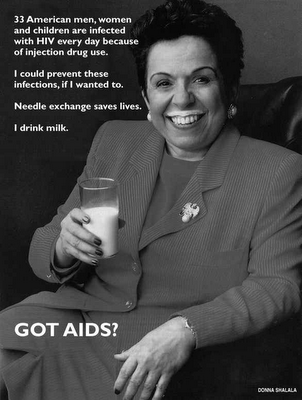
While it's comforting to know that my memory isn't completely gone, the next question is: Is Shalala's memory gone? Or is she simply correcting the record now that she's no longer bound to take the hit for the President? Did Congress set the HHS Secretary up to be the fall guy on needle exchange after cutting some deal with President Clinton that he would not allow her to certify the safety of these programs?
So whose picture belongs here? Bill Clinton's? Jesse Helms'? Or Mike Leavitt's? We still don't have federal funding for needle exchange programs. The research is even clearer now than it was when Shalala was HHS Secretary.
The darling disease
Is Hollywood burned out? Or, is the media fickle?
I had a chance to visit with family this past weekend. Lots of girl talk, lots of old lady talk. One of the family members is the publisher of a daily newpaper in a small town in Texas. I didn't want to be a pest about HIV and Texas AIDS Network, but I was delighted when there was even a brief opportunity to talk about this work that I do. I took it as an opportunity to refine some thoughts that I've been having about HIV and the media. The conversation moved on before I got a chance to finish the refinement, but you're here, no? So let's think about this a bit.
Today's Contra Costa Times brings an article (Tina Daunt, LA Times) that exactly makes my point--in a roundabout way. Daunt writes about Hollywood stars and their many causes. She points out that AIDS was once, as Paul Michael Glaser says, "the darling disease," but now actors might be found working on other things, such as the environment. If they are working to call attention to AIDS, it's just as likely that, like Bono, they are focusing on AIDS in Africa. This has caused some problems for some Los Angeles AIDS organizations, reducing the funds that they are able to raise with the help of Hollywood. After 25 years, however, Daunt (and some of her interview subjects) allow that there is both burnout and complacency because of the available treatments in the U.S.
My thoughts, as I expressed them this weekend (or would have had I been a little pushier with the ladies), are that Hollywood is not necessarily the culprit here. After all, each of us is attracted to some issues more than to others. HIV seems to have claimed my heart, but it could just as easily have been diabetes or heart disease or cancer or hemophilia or substance abuse or urban planning or . . . something else. People have different interests, and, for all the glitter in Hollywood, actors turn out to be just folks.
What may be more critical here, even in terms of Daunt's article, is the media. Among the points I managed to squeeze in over Diet Coke and conversation is that there are really very few stories today about AIDS in the media. My publisher relative brought the subject up herself, intending to say, I think, that the number of news stories was really quite few. That in itself is true. Twenty years ago, there were dozens of stories about AIDS each day. The total number of U.S. media stories about AIDS might have been in the thousands in some years. Not so much these days.
What I tried to express, however, is that if you discount the repetitions of various stories, there are really only a few basic stories being told at all these days. There are variations, but the news story is the same.
I had a chance to visit with family this past weekend. Lots of girl talk, lots of old lady talk. One of the family members is the publisher of a daily newpaper in a small town in Texas. I didn't want to be a pest about HIV and Texas AIDS Network, but I was delighted when there was even a brief opportunity to talk about this work that I do. I took it as an opportunity to refine some thoughts that I've been having about HIV and the media. The conversation moved on before I got a chance to finish the refinement, but you're here, no? So let's think about this a bit.
Today's Contra Costa Times brings an article (Tina Daunt, LA Times) that exactly makes my point--in a roundabout way. Daunt writes about Hollywood stars and their many causes. She points out that AIDS was once, as Paul Michael Glaser says, "the darling disease," but now actors might be found working on other things, such as the environment. If they are working to call attention to AIDS, it's just as likely that, like Bono, they are focusing on AIDS in Africa. This has caused some problems for some Los Angeles AIDS organizations, reducing the funds that they are able to raise with the help of Hollywood. After 25 years, however, Daunt (and some of her interview subjects) allow that there is both burnout and complacency because of the available treatments in the U.S.
My thoughts, as I expressed them this weekend (or would have had I been a little pushier with the ladies), are that Hollywood is not necessarily the culprit here. After all, each of us is attracted to some issues more than to others. HIV seems to have claimed my heart, but it could just as easily have been diabetes or heart disease or cancer or hemophilia or substance abuse or urban planning or . . . something else. People have different interests, and, for all the glitter in Hollywood, actors turn out to be just folks.
What may be more critical here, even in terms of Daunt's article, is the media. Among the points I managed to squeeze in over Diet Coke and conversation is that there are really very few stories today about AIDS in the media. My publisher relative brought the subject up herself, intending to say, I think, that the number of news stories was really quite few. That in itself is true. Twenty years ago, there were dozens of stories about AIDS each day. The total number of U.S. media stories about AIDS might have been in the thousands in some years. Not so much these days.
What I tried to express, however, is that if you discount the repetitions of various stories, there are really only a few basic stories being told at all these days. There are variations, but the news story is the same.
- A celebrity attends a fundraiser.
- AIDS is a big problem in Africa.
- Researchers have passed another step in development of a drug (usually in the business or scientific press).
- It's World AIDS Day.
- There's a management problem at an ASO (fortunately, not too many of these).
- We're still trying to figure out where AIDS came from.
- People are arguing over abstinence.
Are there others? This is just the riff that I can gave off the top of my head, but I think it's not a bad summary.
What I didn't get to say to the ladies, but what I thought when I read Daunt's article, is "it's the media, stupid!" It's the media that has burned out on the issue, that has gotten bored and moved on to other causes.
The result is that we are stuck in a time warp of information. People are left with the old stories and ideas--that HIV is a gay disease, that it's not an issue that the general public needs to be concerned about. At the same time, the paucity of story lines adds another distortion--AIDS is a concern in Africa, but not in the U.S.; we just really don't know the best way to promote prevention; we have drugs to deal with that now (so why worry?).
I recall a conversation with a businessperson, some time in the 1980's, when I mentioned a conference session being planned about AIDS. Her remark sticks in my memory: "AIDS is very vogue right now." Maybe that's Daunt's point--that AIDS is no longer "vogue" in Hollywood. Mine is that, vogue or not, the media isn't covering the epidemic in the U.S. Maybe they're too busy covering Hollywood.
Wednesday, June 14, 2006
Tidbits from "The Age of AIDS"
The PBS Frontline documentary, The Age of AIDS, can be viewed online in segments. A transcript is also available: Part One, Part Two.
Biggest surprise:
I always thought that it was Shalala's hesitancy that blocked federal funding for needle exchange programs. It's interesting that she now lays it on Clinton, who lays it on Congress. The law at the time was that no funds could be spent unless the HHS Secretary (that would be Shalala) could certify that research showed that needle exchange programs did not contribute to increased drug use but did reduce HIV infections. She just never could be persuaded by the evidence. Of course Congress was the big stumbling block, but, if Shalala ever endorsed needle exchange as a means to reduce the spread of HIV, I don't recall that she ever did it where anyone could hear it.
Favorite line:
This is not an anti-church sentiment; Thailand is a Buddhist country, so the values of its people are different. Those values helped in the fight against HIV; Thailand's condom campaign reduced infections by 90 percent. The country is less tolerant of drug use. There has been no acceptance of needle exchange programs, so the epidemic continues to spread among drug users.
Made me angry:
Of course, we never learn, do we? For the time being, the restraints on PEPFAR have regarding "promoting prostitution" have been partially lifted, but there is every indication that new language in the Ryan White CARE Act will go further than Jesse Helms ever dreamed and ban any education that might "promote sex, whether heterosexual or homosexual."
Made me cry:
The epidemic continues to be overwhelming in any number of ways, not the least of which is the continuing stigma of having HIV, the political nonsense that gets in the way of effective public health, and the perpetual frustration with lack of resources. At least we have hope.
If you missed "The Age of AIDS" when it was shown last week, make some time to watch it online or read the transcript.
Biggest surprise:
DONNA SHALALA: Forty percent of new AIDS infections came from IV drug use. I believed that we had an opportunity here for at least a narrow part of the campaign to eliminate new AIDS infections, to make a real contribution.
NARRATOR: But the Republicans who controlled Congress cast AIDS prevention in moral terms.
REP. DENNIS HASTERT (R), Illinois: If drugs are illegal in this country, and it's illegal to use cocaine or heroin or anything that's injectable, then you know, we shouldn't be handing out free utensils.
Pres. BILL CLINTON: The opposition to it was simply overwhelming.
Rep. MARK SOUDER (R), Indiana: -because you think the cause is right, to violate the law and enable people to violate the law-
Pres. BILL CLINTON: It was overwhelming in Congress and it was overwhelming within the drug control office of the administration, and it simply would have been reversed in the Congress if I'd done it. It just wasn't- politically, the country wasn't
ready for it.DONNA SHALALA: I believe the president made the wrong decision. I said so at the time. No one tried to debate with me what the science said or what the right thing to do was, there was simply a straight political decision that was made.
I always thought that it was Shalala's hesitancy that blocked federal funding for needle exchange programs. It's interesting that she now lays it on Clinton, who lays it on Congress. The law at the time was that no funds could be spent unless the HHS Secretary (that would be Shalala) could certify that research showed that needle exchange programs did not contribute to increased drug use but did reduce HIV infections. She just never could be persuaded by the evidence. Of course Congress was the big stumbling block, but, if Shalala ever endorsed needle exchange as a means to reduce the spread of HIV, I don't recall that she ever did it where anyone could hear it.
Favorite line:
MECHAI VIRAVAIDYA: The religious institutions of this country have been extremely helpful. And luckily, we didn't have the church that kept on saying, "Don't use the condoms, don't use the condoms." That just shows you, with good leadership, real political commitment and financial commitment and great common sense, things can happen.
This is not an anti-church sentiment; Thailand is a Buddhist country, so the values of its people are different. Those values helped in the fight against HIV; Thailand's condom campaign reduced infections by 90 percent. The country is less tolerant of drug use. There has been no acceptance of needle exchange programs, so the epidemic continues to spread among drug users.
Made me angry:
Dr. MERVYN SILVERMAN: Due to Senator Jesse Helms, we could not fund anyone who would talk about homosexual sexual activities in their prevention activities. That's like saying we want to try and stop alcoholic-related deaths on the highway, but we can't talk about booze and we can't talk about cars. I mean, you can't do that. Without question, politics has been one of the driving forces in the spread of this disease.
Of course, we never learn, do we? For the time being, the restraints on PEPFAR have regarding "promoting prostitution" have been partially lifted, but there is every indication that new language in the Ryan White CARE Act will go further than Jesse Helms ever dreamed and ban any education that might "promote sex, whether heterosexual or homosexual."
Made me cry:
Dr. GLENDA GRAY: As HIV became more frequent and more commonplace in children, and as they needed more and more care, the ICUs in the country also made decisions not to admit children with HIV into their ICUs because it was terminal, and we needed to keep the beds open for children who had better prognosis. HIV became the new apartheid in South Africa. You know, we discriminated not on race anymore, but on HIV status.
The epidemic continues to be overwhelming in any number of ways, not the least of which is the continuing stigma of having HIV, the political nonsense that gets in the way of effective public health, and the perpetual frustration with lack of resources. At least we have hope.
If you missed "The Age of AIDS" when it was shown last week, make some time to watch it online or read the transcript.
Monday, June 12, 2006
Who's at risk for AIDS?
For several years, we had one of those static cling sticker things on the bathroom mirror at the office. It read: 'Who's at risk for AIDS?" You were supposed to look in the mirror and see the answer.
One of the 25th anniversary news articles (USA Today: "Profile: Generation AIDS") included this point [emphasis added]:
I don't disagree with these statements at all, but I highlighted the points about AIDS-as-gay-disease because that was the very first image of AIDS in the media, and we never seem to have gotten past that--even after 25 years. Right now, the demographics of HIV are indicating that it is turning into an epidemic threat to Black women. However, it would, I believe, be a mistake to once again try to characterize the epidemic by those who are infected by the virus.
The sense that "I am not at risk" comes from the tendency to characterize the epidemic in terms of population and not in terms of behavior. Individuals, regardless of sexual orientation, gender, race, age, ethnicity, or preferred pronunciation of "potato," who engage in high risk behavior that is not mitigated by one or more harm reduction strategies, can become infected with HIV if they engage in those unmitigated high risk behaviors in the presence of HIV.
This point matters in the context of determining an appropriate strategy for prevention in the broader community. Do you try to concentrate resources for those who are most affected by the epidemic (whack-a-mole)? Do you look at a broader strategy to address the fact that high risk behaviors are not necessarily concentrated in those groups (shock and awe)?
I don't have the answer. I tend to prefer the latter strategy, although I know that there are all sorts of arguments against it, not the least of which is the fact that we simply don't have enough prevention dollars to waste on the wrong strategy (abstinence-only, for example). However, "Wear a condom" has become so standard around our house, that the hubby once even told the grandson, "If you burn the house down, make sure you wear a condom." And I couldn't help but cringe when I read this blog entry about a young woman's affair. She only ended up pregnant, but I couldn't help thinking: "What educated woman in the 21st century would put herself and her husband at risk by not insisting on a condom?"
One of the 25th anniversary news articles (USA Today: "Profile: Generation AIDS") included this point [emphasis added]:
The lingering impression that AIDS is a gay disease helped promote its spread among blacks, says Pernessa Seele, founder of Balm in Gilead, a New York-based AIDS advocacy organization that works with 15,000 churches nationwide.
"The fundamental problem with the African-American community is that information about HIV came at us wrong," she says. "It came to us that this was a gay white disease, you don't have to worry about it. Then it was homosexuals and drug addicts. We're still suffering from the wrong information."
I don't disagree with these statements at all, but I highlighted the points about AIDS-as-gay-disease because that was the very first image of AIDS in the media, and we never seem to have gotten past that--even after 25 years. Right now, the demographics of HIV are indicating that it is turning into an epidemic threat to Black women. However, it would, I believe, be a mistake to once again try to characterize the epidemic by those who are infected by the virus.
The sense that "I am not at risk" comes from the tendency to characterize the epidemic in terms of population and not in terms of behavior. Individuals, regardless of sexual orientation, gender, race, age, ethnicity, or preferred pronunciation of "potato," who engage in high risk behavior that is not mitigated by one or more harm reduction strategies, can become infected with HIV if they engage in those unmitigated high risk behaviors in the presence of HIV.
This point matters in the context of determining an appropriate strategy for prevention in the broader community. Do you try to concentrate resources for those who are most affected by the epidemic (whack-a-mole)? Do you look at a broader strategy to address the fact that high risk behaviors are not necessarily concentrated in those groups (shock and awe)?
I don't have the answer. I tend to prefer the latter strategy, although I know that there are all sorts of arguments against it, not the least of which is the fact that we simply don't have enough prevention dollars to waste on the wrong strategy (abstinence-only, for example). However, "Wear a condom" has become so standard around our house, that the hubby once even told the grandson, "If you burn the house down, make sure you wear a condom." And I couldn't help but cringe when I read this blog entry about a young woman's affair. She only ended up pregnant, but I couldn't help thinking: "What educated woman in the 21st century would put herself and her husband at risk by not insisting on a condom?"
Subscribe to:
Posts (Atom)

