Happy new year!
Putting things together for the new year, getting organized, setting up calendars--it's like the first day of school with pencils all sharpened and a brand new notebook to fill. What a bummer it is then to find out that one of my proudest accomplishments for the last few weeks, the 2007 Bill Track List, may not have been publicly accessible as intended.
As it turns out, Google makes us go through two steps to grant public access to one of it Documents & Spreadsheets. Without boring you with the details, I'll just point out that I only recently discovered the second step. I have now taken the second step, and the Bill Track should be viewable at the link above. If not, would some kind soul let me know?
Tuesday, January 02, 2007
Thursday, December 21, 2006
Circumcize Texas (?)
Male circumcision has been discovered to prevent as much as 50 percent of infection for men. It is even protective for women, reducing their rates of infection substantially.
The discussion in Africa now is whether to promote male circumcision and even whether to make it mandatory. Tanzania, for example, is considering whether to implement "mass circumcision" for its male citizens.
This raises the question: should this policy be discussed in Texas?
The discussion in Africa now is whether to promote male circumcision and even whether to make it mandatory. Tanzania, for example, is considering whether to implement "mass circumcision" for its male citizens.
This raises the question: should this policy be discussed in Texas?


More Blogger buzz(ing)
After some months of fiddling with a new version of Blogger, the Blogger folks say that it's out of beta and ready to use. They also say that it's time to shift all blogs to the new Blogger.
Hmph!
It's not happening here. Not that I don't want to shift to the new Blogger. After having panned it as inadequate for our needs, I am now eager to make the shift. For one thing, the new Blogger works better for email subscriptions. For another, it turns out that I like the categorization option. (I have secretly been playing with the new Blogger for, well, fun.)
So. I've backed up the template. I'm all ready to rework the sidebar. I'm eager to add some new subscribers. But it's not happening.
So. I'm linking to the article where the Blogger folks say it's gonna happen, so they can see (a) the link and (b) that I want to shift the blog! Sooner rather than later, guys.
Hmph!
It's not happening here. Not that I don't want to shift to the new Blogger. After having panned it as inadequate for our needs, I am now eager to make the shift. For one thing, the new Blogger works better for email subscriptions. For another, it turns out that I like the categorization option. (I have secretly been playing with the new Blogger for, well, fun.)
So. I've backed up the template. I'm all ready to rework the sidebar. I'm eager to add some new subscribers. But it's not happening.
So. I'm linking to the article where the Blogger folks say it's gonna happen, so they can see (a) the link and (b) that I want to shift the blog! Sooner rather than later, guys.
Recall, recall!
Oh, dear! Yesterday's post regarding "AIDS in the Media" was an unfinished draft of an article that I am working on. I accidentally published it instead of saving it to drafts, and Feedburner/FeedBlits did their thing, sending it out to all our subscribers. Alas and alackaday! I hope you were not unduly confused by the thing just fizzling out before it reached any real conclusion. I've "unpublished" the article, properly saving it to drafts this time. This means you'll see it again someday. In the meantime, please delete the article from your email inbox or feed reader. It's not ready for prime time.
Tuesday, December 19, 2006
Sex, Drugs, & Money
I gave a policy briefing at the 15th Texas HIV/STD Conference along with Randall Ellis, Government Relations Director for Legacy Community Health Services. Called "Sex, Drugs, & Money," the briefing included discussion of the cultural context for HIV/AIDS policy in Texas, resources for local advocates, and an outline of issues that we will (or may) see in the 80th Texas Legislature. While only about 10 people had preregistered for the session, closer to 50 showed up. I was most pleased by the attendance; unfortunately, we did not have enough handouts for everyone who was present.
As promised, I have now published my presentation on the Texas AIDS Network website as a PDF file. I used my version of "beyond bullets" to create my presentation in PowerPoint, using graphics and very few words on my slides, but writing extensive commentary in the notes. While the "notes" are not a script of what I had to say in the briefing, they do give the flavor of what we talked about.
My thanks to all who attended the session. I look forward to working with you in the coming months.
As promised, I have now published my presentation on the Texas AIDS Network website as a PDF file. I used my version of "beyond bullets" to create my presentation in PowerPoint, using graphics and very few words on my slides, but writing extensive commentary in the notes. While the "notes" are not a script of what I had to say in the briefing, they do give the flavor of what we talked about.
My thanks to all who attended the session. I look forward to working with you in the coming months.
Tuesday, December 12, 2006
STAR+PLUS delayed
The feds have not yet approved Texas' waiver application to extend STAR+PLUS coverage to the rest of the state, so plans to roll the program out in Travis, Bexar, Nueces service areas by January 1, 2007, have been put on hold. The Harris County STAR+PLUS program will continue uninterrupted, and eligible clients in other parts of the state will continue to be served by Medicaid.
More information from the Health and Human Services Commission is available here.
More information from the Health and Human Services Commission is available here.
Tuesday, November 28, 2006
What DSHS says about HIV
On August 31, Commissioner Eduardo Sanchez presented the Texas Department of State Health Services Legislative Appropriations Request to the Legislative Budget Board. He used a PowerPoint presentation that included 44 slides. Slides 27 and 28 are reproduced below.
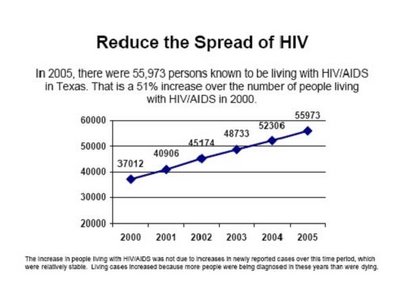
Regarding Slide 27 (above), his Notes page said:

The questions that next come to mind are: If that happens, what will happen to the funds that were targeted for prevention, services, and surveillance? Will they just disappear also? If they continue to be included in the LAR, do they stand a chance of approval without the added "muscle" of a request for medication funds?
To begin looking for answers to those questions I returned to the Commissioner's presentation to see what he was saying before these questions arose. Oh dear! It looks like HIV prevention, services, and surveillance weren't even part of his spiel. He made nice "Republican" arguments about "productive lives," but he didn't make the connection between the need to increase prevention so that the upward curve of people living with HIV could be straightened out, if not reversed. It looks like we'll have to make the connection for him.
Regarding Slide 27 (above), his Notes page said:
DSHS also administers programs to prevent the spread of HIV. Treatment has improved dramatically. As it does, the number of Texans with HIV grows. People are living longer with HIV--but we must also remember that they are working, paying taxes, and leading healthier, more productive lives.
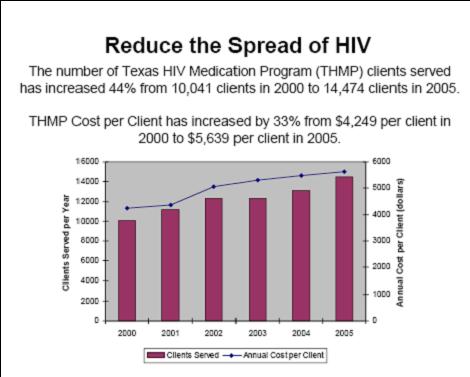
Regarding Slide 28 (above), his Notes page said:
Clients of our HIV medications program are living longer as well. Again, the medications allow these Texans to live fuller, more productive lives and to contribute to the economy. Unfortunately, the cost of the medications used in this program has also grown--by 33% per client since 2000.
This is somewhat old news. However, the new news is that the whole question of an Exceptional Item for HIV in the Department's LAR is now somewhat up in the air. Discussion at the November 17 meeting of the HIV Medication Advisory Committee revealed that, while the estimates for potential funding needs for FY 2008-2009 continue to be based on a shifting foundation, the latest shift in the sands of this foundation suggest that the amount of funding needed will be substantially less that earlier proposed. Indeed, the amount may be sufficiently low that no Exceptional Item request will be made for HIV medications at all--with any amount needed being taken from other programs or resources at DSHS.
Huh?The questions that next come to mind are: If that happens, what will happen to the funds that were targeted for prevention, services, and surveillance? Will they just disappear also? If they continue to be included in the LAR, do they stand a chance of approval without the added "muscle" of a request for medication funds?
To begin looking for answers to those questions I returned to the Commissioner's presentation to see what he was saying before these questions arose. Oh dear! It looks like HIV prevention, services, and surveillance weren't even part of his spiel. He made nice "Republican" arguments about "productive lives," but he didn't make the connection between the need to increase prevention so that the upward curve of people living with HIV could be straightened out, if not reversed. It looks like we'll have to make the connection for him.
Comprehensive sex ed: Who cares?
As it turns out, most US adults do--and they support the inclusion of comprehensive sex ed in public school curriculum. Isn't it interesting, then, that Rep. Warren Chisum hasn't gotten the message? If he had, he certainly wouldn't have filed HB 311, Relating to parental approval of a student's participation in human sexuality instruction in public schools.
Chisum's bill reverses the current opt-out provision for sexuality education in Texas' public schools to make it opt-in. Whereas parents currently have the option of removing their children from sexuality education if that is their desire, now all parents must specifically sign their children up for this education.
Here are some tidbits from the Annenberg National Health Communication Survey, published in the November issue of the Journal of Pediatrics & Adolescent Medicine (and included in a report on Medscape):
So what's the problem, Warren? Could this be a solution in search of a problem?
Chisum's bill reverses the current opt-out provision for sexuality education in Texas' public schools to make it opt-in. Whereas parents currently have the option of removing their children from sexuality education if that is their desire, now all parents must specifically sign their children up for this education.
Here are some tidbits from the Annenberg National Health Communication Survey, published in the November issue of the Journal of Pediatrics & Adolescent Medicine (and included in a report on Medscape):
- The survey was conducted by the Annenberg National Health Communication Survey, a nationally representative measurement of people older than the age of 18 years in the United States. Surveys were conducted by landline telephones between 2005 and 2006.
- Researchers inquired about respondents feelings about 3 different school-based sex education programs: abstinence only, abstinence plus information regarding contraception and prevention of STIs (comprehensive sex education), and comprehensive sex education plus instruction on the use of condoms. Subjects' responses were placed in reference to their self-described political ideology and rates of attendance of religious services.
- 1096 respondents provided study data. The mean age of participants was 46.8 years, and 78.7% of subjects were white. Rates of self-identification as conservative, moderate, or liberal were 35.5%, 39.5%, and 25%, respectively. There was a fairly even distribution across different frequencies of attendance at religious services, with 20.4% reporting no attendance and 21.4% reporting attendance once a week.
- Overall rates of support for comprehensive sex education, comprehensive sex education plus teaching condom use, and abstinence-only education were 82%, 68%, and 36%, respectively. Half of respondents opposed abstinence-only education, making it the most opposed educational option.
- Only 39% of respondents felt that abstinence was an effective means to prevent unplanned pregnancies. However, 80.4% of subjects felt that comprehensive sex education could reduce unintended pregnancies. Most participants disagreed that teaching teenagers to use condoms would encourage them to have sex. Women tended to have higher rates of opposition to abstinence-only programs compared with men.
- More liberal political ideology was associated with greater preference for comprehensive sex education. Rates of support for such programs were 70.0%, 86.4%, and 91.6% among participants with conservative, moderate, and liberal political philosophies, respectively.
- Comprehensive sex education and condom instruction received strong support from respondents who attended religious services a few times a year or less frequently. While abstinence-only programs received more support among subjects who attended church more often, there was equal support for abstinence-only and comprehensive sex education programs among the subgroup of participants who attended services more than once per week.
So what's the problem, Warren? Could this be a solution in search of a problem?
Monday, November 20, 2006
Texas AIDS Network 2007 bill track
The Network will be (as much as time and staff resources permit) posting its tracking list for the 80th Texas Legislature on line. The bill track--so far--has three levels of tracking.
- HIV/STD: Bills on this list specifically address HIV/AIDS or other sexually transmitted diseases. The Network may take a position for or against these bills, may actively support or oppose them through testimony or other means, and may request the Texas HIV/AIDS community to do the same. The Network will also write bill analyses that relate them to the Network's policy principles.
- Related: Bills on this list have the potential to affect HIV/AIDS prevention, treatment, or care even though they do not specifically reference HIV/AIDS or sexually transmitted disease. The Network may take a position for or against these bills, may support or oppose them in hearings, but may not invest significant resources in doing so. The Network will track the progress of these bills and look for changes that may have an effect, either positive or negative, on prevention, treatment, or care.
- Of Interest: Bills on this list have the potential to affect the context, such as the social or overall health care environment, in which HIV/AIDS prevention, treatment, or care occur. The Network will review these bills for negative or positive impact and take action as resources are available. In most cases, the Network will simply monitor their progress through the legislative process.
Bills may be moved from one list to another depending upon Network resources and the degree to which they may be expected to have an effect on HIV/AIDS prevention, treatment, and care.
80th Texas Legislature, Pre-filed bills
The 8th Texas Legislature won't begin until January 9, but legislators are already pre-filing bills. Doing so gives their legislation an official number and a stronger possibility (they hope) of getting their bill passed during the actual session. Once committees are formed in the new session, bills with be formally "read" in the House and Senate and referred to committee where they will be recommended for passage--or die.
You can find a list of the prefiled bills at the Capitol website. Click the link for reports. Make sure that the box for Legislature says "80R - 2007." There are a number of ways to search for bills, including author, subject, and filing date. If you choose filing date, start with November 13 to see bills pre-filed from the beginning--and select every week day thereafter to see all of the bills.
If you want to follow any bills during the session, you can create a "My TLO" account and set up your own tracking lists. I am setting up online tracking lists for Texas AIDS Network using Google Docs & Spreadsheets. You can, if you want to, follow what I'm following by checking the Texas AIDS Network 2007 Bill Track.
You can find a list of the prefiled bills at the Capitol website. Click the link for reports. Make sure that the box for Legislature says "80R - 2007." There are a number of ways to search for bills, including author, subject, and filing date. If you choose filing date, start with November 13 to see bills pre-filed from the beginning--and select every week day thereafter to see all of the bills.
If you want to follow any bills during the session, you can create a "My TLO" account and set up your own tracking lists. I am setting up online tracking lists for Texas AIDS Network using Google Docs & Spreadsheets. You can, if you want to, follow what I'm following by checking the Texas AIDS Network 2007 Bill Track.
Friday, November 10, 2006
Progressing on legislative contact list
At some point, I suppose that my struggles with the legislative contact lists could get boring if all you're interested in is getting your hands on the lists and then using them. It's that latter part that is, of course, my goal in all of this activity. Once the contact lists are completed, you will be able to use them to find contact information for your elected representatives and then start sending letters and faxes, making calls and visits--to tell them about the need for increased funding for HIV and to support good policy for HIV prevention.
Until then, however, I'm busily working away on those lists. A couple of points related to the lists arise.
Until then, however, I'm busily working away on those lists. A couple of points related to the lists arise.
- For Texas House and Senate members, I will eventually list the room number for their offices at the capitol. This room number is not needed for sending mail to them but rather will matter only if you plan to come to Austin for a legislative visit. I have started adding this room number for re-elected incumbents (new legislators won't have an office until later on), but it should not be "trusted" come January and the new legislative session. After every general election, Texas legislators play a sort of "fruit basket turn over" game with offices at the capitol. As "good" offices are vacated by retiring (or defeated) members, others scramble to take over their office space. This means that a lot of legislators will be moving around in the next few weeks--and, of course, that room number will change. Phone numbers will mostly stay the same, but some fax numbers will also change. I will make these "corrections" as the information becomes available.
- Email addresses should be pretty standard for most state legislators. The pattern is (firstname).(lastname)
@house(or senate).state.tx.us. The problem is with that first name, since many legislators have nicknames. Sometimes they use the nickname for their email, sometimes not. Robby Cook, for example, uses his nickname for most purposes, but his email is robert.cook. As my good friend, Gollum, would say: "Tricksy!" If you want to send email to your representative before the list is completed, there are two possibilities. One, take a chance on your legislator following the pattern for creating an email address without any variation. Two, go to the legislator's official web site to send a message via the online email form. To do the latter, start at www.house.state.tx.us or www.senate.state.tx.us to find those official web pages.
Find the lists at Texas Congressional Delegation: 2007-2008 and Texas State Government: 2007-2008. Fee; free to volunteer to help complete these lists. :)
Thursday, November 09, 2006
Legislative contact lists grow
Continuing with the activity of compiling contact information for the 80th Texas Legislature and Texas' delegation to the 110th Congress, I created a second spreadsheet. This one is called "Texas State Government: 2007-2008." The spreadsheet includes separate sheets for the Texas House, Senate, and State Board of Education. There is also a sheet for State Leadership, a catchall for the Governor and anyone else I think you might need to contact at some point.
Once again, volunteers are invited to collaborate on completing these data sheets. While data entry can sometimes be mindnumbing, there is some excitement in chasing down the information. Fax numbers in particular are somewhat elusive as are personal or campaign web sites. Just send an email to cparker AT texasaids DOT net, and I'll sign you up as a collaborator (and be eternally grateful for the help).
Once again, volunteers are invited to collaborate on completing these data sheets. While data entry can sometimes be mindnumbing, there is some excitement in chasing down the information. Fax numbers in particular are somewhat elusive as are personal or campaign web sites. Just send an email to cparker AT texasaids DOT net, and I'll sign you up as a collaborator (and be eternally grateful for the help).
Wednesday, November 08, 2006
2006 election results
Results are in (mostly) for the 2006 mid-term election. Unlike some other states, Texas did not vote for much of a change. Most incumbents won re-election; the Republican Party retains control of most branches of state government and continues to dominate the Texas congressional delegation.
Detailed election results for state- and federal-level races are available from the Secretary of State.
In preparation for new congressional and legislative sessions, I have begun compiling contact information for our various representatives. I will be using Google Docs & Spreadsheets for this effort. The spreadsheets can be imported and exported in various formats so that you can download them to your own computer and sort them as you prefer. Good news, from my perspective, is that Google has set this service up so that authors can collaborate with others on both documents and spreadsheets. That means that you can volunteer to help in this effort!
The first spreadsheet that I have set up is "Texas Congressional Delegation: 2007-2008." When completed, this spreadsheet will include contact information for Texas members of the U. S. House of Representatives and Senate. If you want to help complete this set of data, drop me an email at cparker AT texasaids DOT net. I'll add you as a collaborator, and you can get right to work.
Other spreadsheets will be prepared for the Texas House, Senate, and State Board of Education. Again, if you want to help with this effort, send me an email and I will add you as a collaborator. (More collaborators, faster work.)
One other result of the election is that the 80th Texas Legislature, while it begins its regular session in January, will begin pre-filing legislation tomorrow. The capitol website will allow you to see these bills as they are filed and to set up your own tracking list for them. Expect this session to be an active one for HIV-related legislation.
Detailed election results for state- and federal-level races are available from the Secretary of State.
In preparation for new congressional and legislative sessions, I have begun compiling contact information for our various representatives. I will be using Google Docs & Spreadsheets for this effort. The spreadsheets can be imported and exported in various formats so that you can download them to your own computer and sort them as you prefer. Good news, from my perspective, is that Google has set this service up so that authors can collaborate with others on both documents and spreadsheets. That means that you can volunteer to help in this effort!
The first spreadsheet that I have set up is "Texas Congressional Delegation: 2007-2008." When completed, this spreadsheet will include contact information for Texas members of the U. S. House of Representatives and Senate. If you want to help complete this set of data, drop me an email at cparker AT texasaids DOT net. I'll add you as a collaborator, and you can get right to work.
Other spreadsheets will be prepared for the Texas House, Senate, and State Board of Education. Again, if you want to help with this effort, send me an email and I will add you as a collaborator. (More collaborators, faster work.)
One other result of the election is that the 80th Texas Legislature, while it begins its regular session in January, will begin pre-filing legislation tomorrow. The capitol website will allow you to see these bills as they are filed and to set up your own tracking list for them. Expect this session to be an active one for HIV-related legislation.
Tuesday, October 31, 2006
Accountability and an olive branch
Dr. Gary F. Clark has written a comment on yesterday's blog article on "Accountability and World AIDS Day 2006." His comment is so important that I am responding in a new article so that I can address his points more fully. Dr. Clark says:
We, meaning Americans here but clearly applicable in other societies, have always viewed the epidemic as something that happens to the less-worthy "other." It has always been a dividing point between us and them, whoever "them" might be at any point in the epidemic.
Dr. Clark points out that "we are all humans." Oh, very yes! I recall a speech I made in San Angelo soon after I first came to Texas AIDS Network in which I talked about my sense that the AIDS epidemic was casting a very harsh spotlight on the cracks in the foundation of our society. Since AIDS seemed most to affect those whom we Americans were most willing to throw away--gay men, people of any color besides white, children, women--it seemed to me that the AIDS epidemic gave us the perfect opportunity to repair those cracks. Since HIV is an equal opportunity virus, I said, we need to rethink the divisions that hold us apart and realize that we are all affected by AIDS in one way or another. Therefore, I said, it behooves us to let go of those divisions and begin to work together to end the epidemic as well as the divisions.
Lo, these many years later, the divisions still exist. Rather than taking the opportunity to repair those cracks, we've used the HIV epidemic to widen them. And, while my comments regarding the World AIDS Day 2006 theme of accountability were not intended to be divisive, they were certainly intended to be aggressive.
I'm getting older by the minute and tireder. I am tired of the rhetoric about gay people and those who would use that rhetoric to hinder effective HIV prevention. Get over it already. I am tired of the lies that are told about condoms in the misguided hope that young people will cross their legs and remain abstinent. The result is that they are crossing their fingers instead of their legs--and putting themselves at greater risk for disease and pregnancy. I'm tired of ignorance about science in our country. And, while I'm making that point, could I just ask: How is it that the science that tells us to take an aspirin to help prevent heart disease is better than the science that prevents cervical cancer? I'm tired of the hypocrisy that claims to hold to a particular moral philosphy and then violates that philosophy in word and in deed. Did "do unto others" suddenly change from "as you would have them do unto you" into "as much as you can get away with"?
I'm tired of these things, but I'm not so tired that I wouldn't sit down with folks and talk about ways to move forward on treating and preventing HIV. What I am too tired to do is to allow them to change the subject to a side issue that isn't about HIV at all but rather looks at some other agenda. If we can't talk about the same subject, we're not talking at all.
Dr. Clark is absolutely right, of course. His recommendation has been my philosophy and my practice for years. The only problem is, I can't seem to get some folks to take that olive branch. Isn't it time we held them accountable for that?
I agree that the issue of accountability applies to both sides of this issue. However, rather than being divisive and aggressive, perhaps an olive branch would be more effective. Stressing overlap[p]ing interests is often much more effective than emphasizing differences. The key goal must be to cure AIDS, but first that will take real understanding.My first response to Dr. Clark's comments was somewhat defensive. Being divisive is not such a good thing in my world view. A moment or two of thinking about the matter, however, led me to opine that we are already divided on the issue of HIV and have been since the beginning of the epidemic.
. . .
In summary, rather than citing differences, maybe AIDS activists can come together with everyone in the world by emphasizing that we are all humans that are negatively impacted by these disease states. And that fighting with each other is not the right answer!
We, meaning Americans here but clearly applicable in other societies, have always viewed the epidemic as something that happens to the less-worthy "other." It has always been a dividing point between us and them, whoever "them" might be at any point in the epidemic.
Dr. Clark points out that "we are all humans." Oh, very yes! I recall a speech I made in San Angelo soon after I first came to Texas AIDS Network in which I talked about my sense that the AIDS epidemic was casting a very harsh spotlight on the cracks in the foundation of our society. Since AIDS seemed most to affect those whom we Americans were most willing to throw away--gay men, people of any color besides white, children, women--it seemed to me that the AIDS epidemic gave us the perfect opportunity to repair those cracks. Since HIV is an equal opportunity virus, I said, we need to rethink the divisions that hold us apart and realize that we are all affected by AIDS in one way or another. Therefore, I said, it behooves us to let go of those divisions and begin to work together to end the epidemic as well as the divisions.
Lo, these many years later, the divisions still exist. Rather than taking the opportunity to repair those cracks, we've used the HIV epidemic to widen them. And, while my comments regarding the World AIDS Day 2006 theme of accountability were not intended to be divisive, they were certainly intended to be aggressive.
I'm getting older by the minute and tireder. I am tired of the rhetoric about gay people and those who would use that rhetoric to hinder effective HIV prevention. Get over it already. I am tired of the lies that are told about condoms in the misguided hope that young people will cross their legs and remain abstinent. The result is that they are crossing their fingers instead of their legs--and putting themselves at greater risk for disease and pregnancy. I'm tired of ignorance about science in our country. And, while I'm making that point, could I just ask: How is it that the science that tells us to take an aspirin to help prevent heart disease is better than the science that prevents cervical cancer? I'm tired of the hypocrisy that claims to hold to a particular moral philosphy and then violates that philosophy in word and in deed. Did "do unto others" suddenly change from "as you would have them do unto you" into "as much as you can get away with"?
I'm tired of these things, but I'm not so tired that I wouldn't sit down with folks and talk about ways to move forward on treating and preventing HIV. What I am too tired to do is to allow them to change the subject to a side issue that isn't about HIV at all but rather looks at some other agenda. If we can't talk about the same subject, we're not talking at all.
Dr. Clark is absolutely right, of course. His recommendation has been my philosophy and my practice for years. The only problem is, I can't seem to get some folks to take that olive branch. Isn't it time we held them accountable for that?
Monday, October 30, 2006
Accountability and World AIDS Day 2006
According to Gretta Curtis of Christian Today, the theme for World AIDS Day (December 1) 2006 is accountability:
Curtis' article explores the theme in some detail, providing an international context for the concept.
The concept of accountability is a complex one. It is certainly au courant in the US, being used in one way or another in just about every political campaign we see these days. I'd like to see some exploration of the concept in terms of the current HIV epidemic in Texas.
Can we look for accountability from those who:
The theme of accountability, with the slogan 'Stop AIDS: Keep the Promise', was chosen in consultation with civil society campaign groups to stress the critical need to meet current commitments to increase the global response to AIDS and bring universal access to treatment, care and prevention by 2010.
Curtis' article explores the theme in some detail, providing an international context for the concept.
The concept of accountability is a complex one. It is certainly au courant in the US, being used in one way or another in just about every political campaign we see these days. I'd like to see some exploration of the concept in terms of the current HIV epidemic in Texas.
Can we look for accountability from those who:
- argue against increased funding for HIV prevention, services, and treatment?
- continue to cite false information about the effectiveness of condoms, with the result that sexually active young people now distrust condoms to protect them against HIV?
- offer false hope to people living with HIV by promoting junk science and questionable products, turning them away from proven therapies and better health?
- block effective sex education in our public schools, depriving young people of scientifically correct information that they need to remain healthy, all because of wishful thinking that "just say no" is an actual prevention strategy?
- people who claim to be moral but who also have no charity in their attitudes toward people living with HIV, as if leaving them to suffer were the righteous thing to do?
Yes, I'd like to see some real accountability in our fight against HIV. Wouldn't you?
Return to work studies
The current issue of WORK: A Journal of Prevention, Assessment and Rehabilitation (Volume 27, Number 3, 2006) is a special issue called : HIV/AIDS and Employment: The Continuing Challenge. According to Medical News Today:
The collection of articles in this issue of WORK explores all of these matters and more. Unfortunately, only the article abstracts are available on line. Ordering the full issue will set you back almost $250, but you can recommend that your local library acquire it or get it for you on
interlibrary loan.
Persons living with HIV/AIDS, often diagnosed in the first few decades of their lives, may now face decades more of life while managing the illness. Increasingly, the population of persons with HIV/AIDS consists of women, persons of color, and persons who have poor social supports and limited education and financial resources. In addition, many persons with HIV/AIDS may be challenged with mental illness, substance abuse, homelessness and other co-morbid conditions. Not surprisingly, people with HIV/AIDS struggle to overcome significant challenges that affect their abilities to live independently and return to the workforce.
The collection of articles in this issue of WORK explores all of these matters and more. Unfortunately, only the article abstracts are available on line. Ordering the full issue will set you back almost $250, but you can recommend that your local library acquire it or get it for you on
interlibrary loan.
Thursday, October 12, 2006
Parazapper zapped by FDA
The Parazapper is a fraudulent device that has been marketed as a cure for athelete's foot, diarrhea, HIV, and just about any other illness that can attributed to bacteria, fungus, or critters invading the body. It has been around, either on the market or touted as a do-it-yourself cure, for years. In essence, a parazapper is a metal rod connected by wires to a battery. You use it to zap yourself and the critters that have invaded you, thereby effecting a cure.
I'm not even going to bother with the usual blather about "no scientific evidence," yadda yadda. This product is just pure cr@p. People who market it are preying upon sick people, trying to take their money while promising them the impossible.
I was surprised to find a notice in my mailbox today that the FDA had had to send a warning letter out to a company that was actually marketing this product. Not surprised that the FDA sent the warning, but that there was actually a need to. Do Americans have so little understanding of science that they are gullible enough to buy this stuff?
I'm not even going to bother with the usual blather about "no scientific evidence," yadda yadda. This product is just pure cr@p. People who market it are preying upon sick people, trying to take their money while promising them the impossible.
I was surprised to find a notice in my mailbox today that the FDA had had to send a warning letter out to a company that was actually marketing this product. Not surprised that the FDA sent the warning, but that there was actually a need to. Do Americans have so little understanding of science that they are gullible enough to buy this stuff?
Texas observes NLAAD, October 15
The fourth annual observance of National Latino AIDS Awareness Day (NLAAD) will take place on Sunday, October 15, 2006. Sponsored by the Latino Commission on AIDS, NLAAD is designed to develop awareness, promote prevention and build leadership around HIV/AIDS issues in Latino communities nationwide.
The following is a list of NLAAD-related events taking place around Texas, provided by (but not endorsed by Texas Department of State Health Services, HIV/STD Program, and published in the Texas HIV/STD E-Update).
AUSTIN
The C.A.R.E. Program and the Mission of Restoration Program will sponsor an NLAAD event in East Austin. The event will take place at the Mission of Restoration Drop-In Center, 749 Montopolis Dr., on Friday, October 13. The event will feature HIV testing, counseling, referrals, and information along with drug counseling and referrals, blood pressure/blood sugar tests, and general health information. All services are free. Call 512-247-2222 for more information.
The Texas Department of State Health Services' (DSHS) HIV/STD Program will observe NLAAD with a presentation on HIV-related initiatives along the Texas/Mexico border on Tuesday, October 17 from 10-11:30am in room K-100 (auditorium) at the DSHS main campus, 1100 W. 49th St., in Austin. Scheduled presentations include the Cross-Border HIV/AIDS Multisectorial Policy Group, the Paso del Norte Study of risk behaviors and disease prevalence among IDUs, and the Migrant Clinicians Network. All are welcome to attend this presentation. Call Greg Beets at 512-533-3025 for more information.
CORPUS CHRISTI
The Coastal Bend AIDS Foundation (CBAF) is partnering with the Valley AIDS Council (VAC) Clinic to launch a social marketing campaign to educate Latino/Chicano communities in the Coastal Bend Area about the risk of HIV/AIDS. The campaign also seeks to encourage people to get tested for HIV and to access HIV care services if needed. VAC staff will use the local English and Spanish language media to promote the campaign. Appearances are scheduled on local channels KIII (ABC) and KORO (Univision). The campaign message will be critical to normalizing the presence of HIV as a community problem for the Hispanic/Chicano community. Local HIV/AIDS statistics and trends will be provided and prevention messages will be connected to CBAF’s prevention efforts in Molina, a predominately minority neighborhood on the Westside of Corpus Christi. Testing will be provided at this location from 1-6pm. Testing will also be conducted at CBAF offices on 400 Mann Street, Suite 800, in Corpus Christi from 9am to 5pm. For more information, please call 361-841-2001.
DALLAS
The Dallas County Health & Human Services Department (Mobile Medical Clinic) will co-host two functions to commemorate NLAAD in collaboration with multiple Dallas County community-based organizations. On Sunday October 15, the department will offer HIV/STD education and HIV/syphilis testing in collaboration with Resource Center of Dallas at Kaliente's (parking lot), 4350 Maple Av. at Hondo Av., from 7-11pm. On Monday October 16, the department will provide HIV/STD education and HIV/syphilis testing in collaboration with AIDS Interfaith of Dallas at the Mexican Consulate Office of Dallas, 8855 N. Stemmons Fwy., from 10am to 3pm. For additional information, please contact Monica Tunstle Garrett, Dallas County Health & Human Services, at 214-819-2132.
On Sunday, October 15 from 10am to 2pm, Dallas area HIV-related organizations will commemorate NLAAD with an outreach event at Bachman Lake, located at Bachman Lake Drive and Northwest Hwy. Participating organizations include the Latino Commission on AIDS, Greater Dallas Council on Alcohol & Drug Abuse, Valiente DFW LGBTQ, Mosaic Family Services, Inc., Dallas Legal Hospice, and AIDS Arms, Inc. Trained volunteers will be utilizing the OraQuick Advanced HIV Antibody Test, which provides clients with results in as little as 20 minutes. For additional information regarding this event, please contact Efren Garcia at Greater Dallas Council on Alcohol & Drug Abuse, 214-893-5458.
EL PASO
Planned Parenthood Center of El Paso will conduct HIV awareness and testing events on Wednesday, October 11 from 9am to 1pm at the El Paso Mexican Consulate and on Monday, October 16 at El Paso Community College, Valle Verde Campus, from 10am to 2pm. The goal of these events is to reach as many Latinos as possible in the border area to raise consciousness about the HIV/AIDS epidemic in the Latino community. Other agencies have been invited to participate in this event, including La Fe, Thomason General Hospital, the Binational AIDS Committee, and other local ASOs. Entertainment and Mexican folkloric dances will be part of the program. For more information, contact Tony Ramos at tony.ramosATppcep.org.
Aliviane, Inc. in El Paso will be providing confidential HIV screenings and Texas A & M University Prevention Resource Center will be providing information on HIV/AIDS, STDs and Hepatitis A, B, and C. This event will take place Friday, October 27 from 9-11am at Socorro Ramirez Community Center (Sparks Center), 106 Peyton Road in Horizon City. For more information, contact Emma Munoz, Aliviane, Inc., at 915-782-4042, or Susan Hernandez or Juan Garcia at the Texas A & M University Prevention Resource Center, 915-860-9528.
FORT WORTH
Tarrant County Public Health (TCPH) hosted “Carnaval de Salud” on Saturday, October 7 from 8am to 12pm at 1101 S. Main St. (at Rosedale) in Fort Worth. This wellness event, part of the sixth annual observance of Binational Health Week, included HIV prevention activities. The goal of this event was to provide the Hispanic community with free information on public health as well as screenings for cholesterol, diabetes, high blood pressure, HIV and syphilis. Call 817-321-4700 for more information.
La Gran Plaza Health Fair will take place Saturday, October 14 from 10am to 3pm at the OK Corral Night Club, 4200 South Fwy., in Fort Worth. The goal of this event is to provide the Hispanic community with free information on public health as well as screenings for cholesterol, diabetes, high blood pressure, HIV and syphilis. Please call Santos Navarrette at 817-321-5333 for more information. TCPH will also conduct HIV and syphilis screening at the OK Corral on Saturday night from 9pm to 1am. Please call Brian Barron at 817-321-4863 for more information.
HOUSTON
St. Hope Foundation will provide HIV testing for NLAAD on Sunday, October 15 from 12-5pm at Club Carnaval, 8150 Southwest Fwy., in Houston. For more information, contact W. Jeffrey Campbell at 713-778-1300, ext. 230.
LONGVIEW/TYLER
Special Health Resources for Texas, Inc. (SHRT) will provide education, counseling, and testing in Tyler on Sunday, October 15 at La Michoacana, 310 N. Beckham, from 10am to 4pm, and in Longview on Monday, October 16 at La Michoacana, 1419 S. Green St., from 10am to 4pm. For more information, contact Ernesto Guevara at 903-234-8808, ext. 246.
NACOGDOCHES
Health Horizons of East Texas will conduct a community education and awareness event on Thursday, October 12 at 6pm at 2604 Stallings Drive in Nacogdoches. Free HIV testing will be available. Free HIV testing will also be available on Monday, October 16 at 412 North Street, Suite F. For more information, call toll-free 800-745-8240.
ODESSA
Ector County Health Department will conduct an NLAAD event on Thursday, October 12 from 5-1pm at LULAC’s “La Raza,” located at the University of Texas of the Permian Basin campus at 4901 E. University. For more information, call Jackie Venske or Lynn Gorton at 432-498-4141.
SAN ANTONIO
The San Antonio Prevention Collaborative (SAPC) will be hosting the following NLAAD-related activities:
Thursday October 12
6:30pm: Procession of Hope, San Fernando Cathedral (meet at Main Plaza)
9-12pm: HIV Testing, food, activities, door prizes at Bermuda Triangle, 119 El Mio
Friday October 13
8:30-10:30am: HIV testing and food at University Health System/FFACTS Clinic 527 N. Leona
Saturday October 14
10am-2pm: HIV testing, music, activities, and door prizes at Good Samaritan Center, 1600 Saltillo
7pm-12am: HIV testing and door prizes Stewart Center 1711 Guadalupe St.
Sunday, October 15
12-4pm: Free HIV testing and prizes at “Festival de la Salud,” Alamodome
The SAPC has joined forces to offer HIV screenings to the population in the San Antonio area that might not otherwise access testing sites due to stigma and denial. The collaborative is comprised of Avendida Guadalupe, BEAT AIDS, Good Samaritan, Community Clinic/Project Save, Mujeres Unidas, Hope Action Care, San Antonio Metro Health District (SAMHD), and the University Health System. The SAPC feels that offering a wide range of events in a health fair setting will help reduce the stigma associated with this pandemic. For more information, contact George Perez (SAMHD) at 210-207-8071 or Yvette Moran (Mujeres Unidas) at 210-738-3393.
The San Antonio AIDS Foundation will offer HIV testing from 8am to 6pm on Monday, October 16 at 818 E. Grayson St. For more information, please contact Vanessa Gonzales at 210-225-4715.
The following is a list of NLAAD-related events taking place around Texas, provided by (but not endorsed by Texas Department of State Health Services, HIV/STD Program, and published in the Texas HIV/STD E-Update).
AUSTIN
The C.A.R.E. Program and the Mission of Restoration Program will sponsor an NLAAD event in East Austin. The event will take place at the Mission of Restoration Drop-In Center, 749 Montopolis Dr., on Friday, October 13. The event will feature HIV testing, counseling, referrals, and information along with drug counseling and referrals, blood pressure/blood sugar tests, and general health information. All services are free. Call 512-247-2222 for more information.
The Texas Department of State Health Services' (DSHS) HIV/STD Program will observe NLAAD with a presentation on HIV-related initiatives along the Texas/Mexico border on Tuesday, October 17 from 10-11:30am in room K-100 (auditorium) at the DSHS main campus, 1100 W. 49th St., in Austin. Scheduled presentations include the Cross-Border HIV/AIDS Multisectorial Policy Group, the Paso del Norte Study of risk behaviors and disease prevalence among IDUs, and the Migrant Clinicians Network. All are welcome to attend this presentation. Call Greg Beets at 512-533-3025 for more information.
CORPUS CHRISTI
The Coastal Bend AIDS Foundation (CBAF) is partnering with the Valley AIDS Council (VAC) Clinic to launch a social marketing campaign to educate Latino/Chicano communities in the Coastal Bend Area about the risk of HIV/AIDS. The campaign also seeks to encourage people to get tested for HIV and to access HIV care services if needed. VAC staff will use the local English and Spanish language media to promote the campaign. Appearances are scheduled on local channels KIII (ABC) and KORO (Univision). The campaign message will be critical to normalizing the presence of HIV as a community problem for the Hispanic/Chicano community. Local HIV/AIDS statistics and trends will be provided and prevention messages will be connected to CBAF’s prevention efforts in Molina, a predominately minority neighborhood on the Westside of Corpus Christi. Testing will be provided at this location from 1-6pm. Testing will also be conducted at CBAF offices on 400 Mann Street, Suite 800, in Corpus Christi from 9am to 5pm. For more information, please call 361-841-2001.
DALLAS
The Dallas County Health & Human Services Department (Mobile Medical Clinic) will co-host two functions to commemorate NLAAD in collaboration with multiple Dallas County community-based organizations. On Sunday October 15, the department will offer HIV/STD education and HIV/syphilis testing in collaboration with Resource Center of Dallas at Kaliente's (parking lot), 4350 Maple Av. at Hondo Av., from 7-11pm. On Monday October 16, the department will provide HIV/STD education and HIV/syphilis testing in collaboration with AIDS Interfaith of Dallas at the Mexican Consulate Office of Dallas, 8855 N. Stemmons Fwy., from 10am to 3pm. For additional information, please contact Monica Tunstle Garrett, Dallas County Health & Human Services, at 214-819-2132.
On Sunday, October 15 from 10am to 2pm, Dallas area HIV-related organizations will commemorate NLAAD with an outreach event at Bachman Lake, located at Bachman Lake Drive and Northwest Hwy. Participating organizations include the Latino Commission on AIDS, Greater Dallas Council on Alcohol & Drug Abuse, Valiente DFW LGBTQ, Mosaic Family Services, Inc., Dallas Legal Hospice, and AIDS Arms, Inc. Trained volunteers will be utilizing the OraQuick Advanced HIV Antibody Test, which provides clients with results in as little as 20 minutes. For additional information regarding this event, please contact Efren Garcia at Greater Dallas Council on Alcohol & Drug Abuse, 214-893-5458.
EL PASO
Planned Parenthood Center of El Paso will conduct HIV awareness and testing events on Wednesday, October 11 from 9am to 1pm at the El Paso Mexican Consulate and on Monday, October 16 at El Paso Community College, Valle Verde Campus, from 10am to 2pm. The goal of these events is to reach as many Latinos as possible in the border area to raise consciousness about the HIV/AIDS epidemic in the Latino community. Other agencies have been invited to participate in this event, including La Fe, Thomason General Hospital, the Binational AIDS Committee, and other local ASOs. Entertainment and Mexican folkloric dances will be part of the program. For more information, contact Tony Ramos at tony.ramosATppcep.org.
Aliviane, Inc. in El Paso will be providing confidential HIV screenings and Texas A & M University Prevention Resource Center will be providing information on HIV/AIDS, STDs and Hepatitis A, B, and C. This event will take place Friday, October 27 from 9-11am at Socorro Ramirez Community Center (Sparks Center), 106 Peyton Road in Horizon City. For more information, contact Emma Munoz, Aliviane, Inc., at 915-782-4042, or Susan Hernandez or Juan Garcia at the Texas A & M University Prevention Resource Center, 915-860-9528.
FORT WORTH
Tarrant County Public Health (TCPH) hosted “Carnaval de Salud” on Saturday, October 7 from 8am to 12pm at 1101 S. Main St. (at Rosedale) in Fort Worth. This wellness event, part of the sixth annual observance of Binational Health Week, included HIV prevention activities. The goal of this event was to provide the Hispanic community with free information on public health as well as screenings for cholesterol, diabetes, high blood pressure, HIV and syphilis. Call 817-321-4700 for more information.
La Gran Plaza Health Fair will take place Saturday, October 14 from 10am to 3pm at the OK Corral Night Club, 4200 South Fwy., in Fort Worth. The goal of this event is to provide the Hispanic community with free information on public health as well as screenings for cholesterol, diabetes, high blood pressure, HIV and syphilis. Please call Santos Navarrette at 817-321-5333 for more information. TCPH will also conduct HIV and syphilis screening at the OK Corral on Saturday night from 9pm to 1am. Please call Brian Barron at 817-321-4863 for more information.
HOUSTON
St. Hope Foundation will provide HIV testing for NLAAD on Sunday, October 15 from 12-5pm at Club Carnaval, 8150 Southwest Fwy., in Houston. For more information, contact W. Jeffrey Campbell at 713-778-1300, ext. 230.
LONGVIEW/TYLER
Special Health Resources for Texas, Inc. (SHRT) will provide education, counseling, and testing in Tyler on Sunday, October 15 at La Michoacana, 310 N. Beckham, from 10am to 4pm, and in Longview on Monday, October 16 at La Michoacana, 1419 S. Green St., from 10am to 4pm. For more information, contact Ernesto Guevara at 903-234-8808, ext. 246.
NACOGDOCHES
Health Horizons of East Texas will conduct a community education and awareness event on Thursday, October 12 at 6pm at 2604 Stallings Drive in Nacogdoches. Free HIV testing will be available. Free HIV testing will also be available on Monday, October 16 at 412 North Street, Suite F. For more information, call toll-free 800-745-8240.
ODESSA
Ector County Health Department will conduct an NLAAD event on Thursday, October 12 from 5-1pm at LULAC’s “La Raza,” located at the University of Texas of the Permian Basin campus at 4901 E. University. For more information, call Jackie Venske or Lynn Gorton at 432-498-4141.
SAN ANTONIO
The San Antonio Prevention Collaborative (SAPC) will be hosting the following NLAAD-related activities:
Thursday October 12
6:30pm: Procession of Hope, San Fernando Cathedral (meet at Main Plaza)
9-12pm: HIV Testing, food, activities, door prizes at Bermuda Triangle, 119 El Mio
Friday October 13
8:30-10:30am: HIV testing and food at University Health System/FFACTS Clinic 527 N. Leona
Saturday October 14
10am-2pm: HIV testing, music, activities, and door prizes at Good Samaritan Center, 1600 Saltillo
7pm-12am: HIV testing and door prizes Stewart Center 1711 Guadalupe St.
Sunday, October 15
12-4pm: Free HIV testing and prizes at “Festival de la Salud,” Alamodome
The SAPC has joined forces to offer HIV screenings to the population in the San Antonio area that might not otherwise access testing sites due to stigma and denial. The collaborative is comprised of Avendida Guadalupe, BEAT AIDS, Good Samaritan, Community Clinic/Project Save, Mujeres Unidas, Hope Action Care, San Antonio Metro Health District (SAMHD), and the University Health System. The SAPC feels that offering a wide range of events in a health fair setting will help reduce the stigma associated with this pandemic. For more information, contact George Perez (SAMHD) at 210-207-8071 or Yvette Moran (Mujeres Unidas) at 210-738-3393.
The San Antonio AIDS Foundation will offer HIV testing from 8am to 6pm on Monday, October 16 at 818 E. Grayson St. For more information, please contact Vanessa Gonzales at 210-225-4715.
Tuesday, October 10, 2006
International Carnival of Pozitivities, Fourth Edition
Welcome to the Fourth International Carnival of Pozitivities. The first Carnival was hosted by Ron Hudson at 2sides2ron in July. In August, Brad at AIDS Combat Zone hosted the second Carnival. Last month's host, Richard Kearns, published the third Carnival at AIDS-write.org. This October edition of ICP is hosted here at Texas AIDS Blog by . . . well . . . me.
We are fortunate to have an ever-growing number of participants in the Carnival. This month we are pleased to welcome several new blogs and bloggers to the dialogue about AIDS and the people and communities that are affected by HIV/AIDS. In addition to several contributors from the US, we have contributions from central Asia, southern Africa, Canada, and Mexico. The topics covered by these articles show the diverse responses to the epidemic around the world at the same time they reveal the commonalities of people, places, and problems.
Voice
In many parts of the world, people affected by AIDS have no voice with which to speak to their families and community much less the world about their fears, their suffering, their hopes. This is due in no small part to the strong stigma attached to being HIV-positive, which stifles their voice and condemns them to silence. It is also due to the lack of tools to help project one's voice to those who need to hear it.
Cristi Hegranes writes in "El banco" about the day she took five women to a bank in Chiapas, Mexico, to open their first bank account with their first earnings. As Hegranes' post shows, having a voice is important on many levels:
Blogswana describes itself as "Botswana, AIDS and Blogging." Brian has an August post in Blogswana which incorporates Ron Hudson's "En-COURAGE-ment to Blog for HIV/AIDS," and makes the case for using the voice that we have:
In yet another take on "voice," Jody Kuchar writes about "AIDS WALK 2006" in Gray Matter Flatulence. She writes first about her participation in AIDS walks in Milwaukee and the vicious tactics the "Christian right hate groups" used to intimidate walkers and disrupt the event. Kuchar talks about her reaction to these tactics--anger, not fear--and her decision to put her time and energy into volunteering at a hospice. Still she questioned her decision:
Life after AIDS
By now, most of the world has come to the realization that there really is life after HIV and even life after AIDS. Given the fairy tales found in some pharmaceutical advertising and the distortions of media reports, it is no wonder that many have no clue what that life is like.
Ron Hudson has an "official" contribution to this month's Carnival, but I couldn't pass up his poignant description of "Clearing Out Your Closet." When he first sent me the link to the article, I thought it was going to be an essay about clearing out the mental clutter that keeps us from focusing more clearly on the task before us (which shows you what I need to be doing). Instead, it is a reminder that we all must cope--somehow--with life after AIDS.
Written for this past World AIDS Day, Ron's post is a different take on "the Day" and what it has come to stand for. Positive, proactive, inspirational slogans do help motivate us to keep going, to keep doing the work that we do in prevention, care, policy. All the slogans cannot, however, cover up the underlying grief and loss that we all must feel when World AIDS Day rolls around, when we open the doors to the closets of our memory and do as Ron did:
The Dreamer writes about a different way that those living with HIV must cope with that life. "Mangled in the Medical Machine - 2" is the second part of a three-part series on the nightmare that comes with needing surgery when you are HIV-positive. His blog, appropriately enough, is called Nightmare Hall.
The Dreamer chronicles in vivid detail his medication regime and the effects it has on his HIV disease as well as the debilitating side effects. As the side effects get worse, it is his chronic pain which begins to take over as a major health concern.
High Fiber For The High Fiver is LWood's blog, a delightful take on living with HIV and, as he says, "the way I like to play with labels." I won't give it away, but "Happy Valentines Day (non negatively)" will make you smile.
Routine Testing
The CDC has finally stopped teasing us and issued its recommendation that HIV testing should become a routine part of health care. While I've had my own (cautious) thoughts on the subject, two of our contributors this month chime in with their own thoughts.
Nels Highberg's blog is called A Delicate Boy . . . In the Hysterical Realm. In "Testing, Testing . . . ," he pushes the "on" button and starts listing his concerns about routine testing. He moves from lack of consent to skewed counseling to increased stigma, the latter, I might add, despite the CDC's professed belief that a policy of routine testing will reduce the stigma surrounding testing. Highberg continues with concerns about insurance, criminalization, and--my own hobby horse--the overburdened, underfunded system that provides care for those living with HIV. As Highberg says of AIDS service organizations:
Walter Senterfitt, in a guest post at AIDS-write.org, gives us "CHAMP HHS Watch--A Test of Our Commitment: What would it really take to fix HIV testing?" Senterfitt tosses out a breathtaking array of facts and research findings, all to say "The fix is not in." His argument carefully grants some validity to CDC's proposal for routine testing at the same time he places that proposal in the context of a long line of failed panaceas proposed by the CDC and points out some serious gaps in the proposal.
Senterfitt's own proposal? Comprehensive operations research on the effectiveness of these guidelines at the same time they are being promoted and implemented. He asks:
The lion's share of funding for HIV/AIDS in the US seems to be spent on medical research and treatment. The pittance that is spent on prevention is shrinking both in proportion and in absolute dollars. These facts alone suggest that is becoming increasingly important to make sure that our prevention messages are crystal clear and effectively targeted.
In the Blog to end AIDS, Akira Ohiso looks at Ian Daly's "Whatever Happened to Safe Sex?" Ohiso reports Daly's conclusions, that "denial, fatalism of our current world climate, misleading media information, and the Bush administration's misdirected abstinence education assault" did in safer sex. Ohiso's own opinion:
We are fortunate to have an ever-growing number of participants in the Carnival. This month we are pleased to welcome several new blogs and bloggers to the dialogue about AIDS and the people and communities that are affected by HIV/AIDS. In addition to several contributors from the US, we have contributions from central Asia, southern Africa, Canada, and Mexico. The topics covered by these articles show the diverse responses to the epidemic around the world at the same time they reveal the commonalities of people, places, and problems.
Voice
In many parts of the world, people affected by AIDS have no voice with which to speak to their families and community much less the world about their fears, their suffering, their hopes. This is due in no small part to the strong stigma attached to being HIV-positive, which stifles their voice and condemns them to silence. It is also due to the lack of tools to help project one's voice to those who need to hear it.
Cristi Hegranes writes in "El banco" about the day she took five women to a bank in Chiapas, Mexico, to open their first bank account with their first earnings. As Hegranes' post shows, having a voice is important on many levels:
"maria antonieta, “tonita,” was first. she is so quiet. sitting right next to her i could barely hear her speak. i think she was nervous b/c she doesn’t have a permanent address and she was using a copy of the gas bill from our office as proof of residence. she was asked a million questions, each reply came in a whisper until she was asked for her occupation — “SOY UNA PERIODISTA,” she bellowed. when asked for her place of employment she whipped out her new press pass and declared just as loudly “EL INSTITUTO DE PRENSA PARA MUJERES DE MEXICO.”The Press Institute for Women in the Developing World trains women to become reporters, focusing on six core themes, including AIDS, violence against women, reproductive rights, poverty, political oppression and community development. Those who have something to say about AIDS need a voice; having voice, the benefits accrue to them as well as to their audience.
Blogswana describes itself as "Botswana, AIDS and Blogging." Brian has an August post in Blogswana which incorporates Ron Hudson's "En-COURAGE-ment to Blog for HIV/AIDS," and makes the case for using the voice that we have:
The act of speaking out in your own voice requires courage and strength of character and a strong desire to be heard. For many living in the world [of] HIV/AIDS, our voices have been silenced by fear, anxiety, social stigma and threats of death or injury. Now more than ever, we need to speak out and let the world hear our voices.Not so long after that, Brian posted a lengthy list of "Botswana Blogs," several of which focus on AIDS. Given the tools, it's clear that there is great courage in the HIV/AIDS community.
In yet another take on "voice," Jody Kuchar writes about "AIDS WALK 2006" in Gray Matter Flatulence. She writes first about her participation in AIDS walks in Milwaukee and the vicious tactics the "Christian right hate groups" used to intimidate walkers and disrupt the event. Kuchar talks about her reaction to these tactics--anger, not fear--and her decision to put her time and energy into volunteering at a hospice. Still she questioned her decision:
Whenever my husband and I went to serve dinners or help at hospice, we did do good work and were appreciated for it. But it was silent work - we educated no one, we did not alleviate intolerance or hatred.Now living in Indianapolis, Kuchar is once more determined to make her voice heard: She will walk in AIDS Walk 2006.
Life after AIDS
By now, most of the world has come to the realization that there really is life after HIV and even life after AIDS. Given the fairy tales found in some pharmaceutical advertising and the distortions of media reports, it is no wonder that many have no clue what that life is like.
Ron Hudson has an "official" contribution to this month's Carnival, but I couldn't pass up his poignant description of "Clearing Out Your Closet." When he first sent me the link to the article, I thought it was going to be an essay about clearing out the mental clutter that keeps us from focusing more clearly on the task before us (which shows you what I need to be doing). Instead, it is a reminder that we all must cope--somehow--with life after AIDS.
Written for this past World AIDS Day, Ron's post is a different take on "the Day" and what it has come to stand for. Positive, proactive, inspirational slogans do help motivate us to keep going, to keep doing the work that we do in prevention, care, policy. All the slogans cannot, however, cover up the underlying grief and loss that we all must feel when World AIDS Day rolls around, when we open the doors to the closets of our memory and do as Ron did:
I sat on the bed and watched. He opened the door to your closet and started removing the clothes that hung there, one hanger at a time. He would hold the shirts to him, breathing in deeply to find a hint of your smell.AIDS still kills. Part of the horror is that some of us have to keep on living with the loss.
The Dreamer writes about a different way that those living with HIV must cope with that life. "Mangled in the Medical Machine - 2" is the second part of a three-part series on the nightmare that comes with needing surgery when you are HIV-positive. His blog, appropriately enough, is called Nightmare Hall.
The Dreamer chronicles in vivid detail his medication regime and the effects it has on his HIV disease as well as the debilitating side effects. As the side effects get worse, it is his chronic pain which begins to take over as a major health concern.
By June of 2005 my doctor decided to take me off all meds for an extended [trial] period since my counts [had] remained excellent for so long. The neuropathy [had] grown almost unbearable and my left leg was withering away faster than ever to [where] I was losing my balance and now the right leg began wasting faster and faster....In July my weak leg gave out under me and I fell backward fracturing my spine to boot.The tendency in the healthcare system to blame every illness on HIV rather than look for other causes, the truly experimental nature of HIV treatment for individuals, the increasing need to know one's disease and to reverse patient-doctor roles by becoming the one who is knowledgeable about treatment options--these, too, are part of life after AIDS.
High Fiber For The High Fiver is LWood's blog, a delightful take on living with HIV and, as he says, "the way I like to play with labels." I won't give it away, but "Happy Valentines Day (non negatively)" will make you smile.
Routine Testing
The CDC has finally stopped teasing us and issued its recommendation that HIV testing should become a routine part of health care. While I've had my own (cautious) thoughts on the subject, two of our contributors this month chime in with their own thoughts.
Nels Highberg's blog is called A Delicate Boy . . . In the Hysterical Realm. In "Testing, Testing . . . ," he pushes the "on" button and starts listing his concerns about routine testing. He moves from lack of consent to skewed counseling to increased stigma, the latter, I might add, despite the CDC's professed belief that a policy of routine testing will reduce the stigma surrounding testing. Highberg continues with concerns about insurance, criminalization, and--my own hobby horse--the overburdened, underfunded system that provides care for those living with HIV. As Highberg says of AIDS service organizations:
They don't get the money they need to do they work they want to do. And these new guidelines mention nothing about increased services.Word.*
Walter Senterfitt, in a guest post at AIDS-write.org, gives us "CHAMP HHS Watch--A Test of Our Commitment: What would it really take to fix HIV testing?" Senterfitt tosses out a breathtaking array of facts and research findings, all to say "The fix is not in." His argument carefully grants some validity to CDC's proposal for routine testing at the same time he places that proposal in the context of a long line of failed panaceas proposed by the CDC and points out some serious gaps in the proposal.
Senterfitt's own proposal? Comprehensive operations research on the effectiveness of these guidelines at the same time they are being promoted and implemented. He asks:
wouldn’t it be great it we could turn this next period of predictable resistance and confusion over implementation into a real dialogue among the feds, the docs, the healthcare execs, the community-based organizations serving high-risk communities and the people living with hiv to come up with a comprehensive plan to offer real treatment and real prevention for everyone in at country with, or at risk for, hiv[?]Brian Finch gives us "Nearly all HIV infections come from undiagnosed people" from his blog, Acid Reflux. In this post, Finch is looking at the role that the "unknowing" play in expanding the epidemic in the US. He adds some thoughts on the Canadian context and extensive quotes from an article about sero-sorting among HIV-negative gay men in Australia. Finch's post argues that:
Understanding who is more likely to transmit HIV helps us make our minds up on some of the contentious issues in HIV prevention like universal testing and sero-sorting, and the wisdom of criminalising HIV transmission, which tends to penalise people already aware of their HIV status.Prevention Messaging
The lion's share of funding for HIV/AIDS in the US seems to be spent on medical research and treatment. The pittance that is spent on prevention is shrinking both in proportion and in absolute dollars. These facts alone suggest that is becoming increasingly important to make sure that our prevention messages are crystal clear and effectively targeted.
In the Blog to end AIDS, Akira Ohiso looks at Ian Daly's "Whatever Happened to Safe Sex?" Ohiso reports Daly's conclusions, that "denial, fatalism of our current world climate, misleading media information, and the Bush administration's misdirected abstinence education assault" did in safer sex. Ohiso's own opinion:
. . . , the most egregious reason for the rise in STDs and HIV/AIDS is the religious ideological abstinence and anti-condom message of the Bush administration. The Bush administration and his right-wing gang will support millions of dollars in abstinence education, while cutting spending on prevention programs, fully knowing that prevention programs are much more effective.
Ron Hudson's official entry for this month's Carnival from his blog, 2sides2ron, is "Instructions on How to Use a Condom." As with the earlier essay on clearing closets, I was somewhat nonplussed. What on earth, I thought, was Ron going to say about condom instructions? Was this post even necessary given the abundance of information on the subject.
As it turns out, yes, the post was necessary. As Ron points out, in the context of the ongoing War on Condoms, a free and independent voice is needed to provide life-saving information to those who have been deprived of it or given misleading information. Ron's concern, too, is global: "I hope that this information reaches you in countries that have been forced to accept policy that has failed in the US as well."
Ben posts on neweurasia.net news of a regional HIV/AIDS conference. The existence of neweurasia.net provides another outlet for voice in a world where voice is frequently stifled as a matter of policy. This post focuses on the broad regional interest in HIV/AIDS and a shared concern that prevention funding be adequate to continue trends which, when compared to Russia and the Ukraine, are only "comparatively good."
Can
Our last contribution, "Can," is from Rick Reilly. While this article, originally published in Sports Illustrated, is not a blog post per se, it gives a message that we can all use: Can! (Not can't). Read the article, watch the video (with plenty of tissues handy), and imagine: CAN!
And that concludes ICP-4. If you liked it, please consider linking to it from your site. The next edition will be published on or about November 10. To submit a blog post for inclusion, fill out the submission form on the ICP web site.
Quotable
- "Doctors are not gods, merely highly paid troubleshooters of wetware." -- The Dreamer
- "I just don't think out culture should sugar-coat the realities of [HIV] disease. It kicks ass and hard and you better believe it." -- Ron Hudson
- "I bought into our society's message that gay equaled AIDS." -- Nels P. Highberg
- "AIDS seems to be a disease of 'those people' again." -- Nels P. Highberg
*Yes, I know that "nobody says 'word'" anymore. Meh.
Tuesday, September 26, 2006
More money for FDA!
Diedtra Henderson writes for the Boston Globe about a new coalition that has formed to lobby for a bigger appropriation for the FDA. Yea, verily. As federal agencies go, the FDA is one of the most important for the health and safety of the American people, yet it is chronically underfunded. A little e coli in the vegetable supply goes a long way toward reminding folks that the "F" in FDA stands for food, and this is the agency that sets standards and conducts inspections. There's also the "D" in FDA, which makes one wonder about this:
Yo, PhRMA! It's a no brainer.
Pharmaceutical Research and Manufacturers of America, the pharmaceutical industry's trade association, said in a statement that a decision whether to join the Coalition for a Stronger FDA is ``still under consideration." It also has not decided whether to endorse redirecting user fees to help improve drug safety.
Yo, PhRMA! It's a no brainer.
Subscribe to:
Posts (Atom)

